
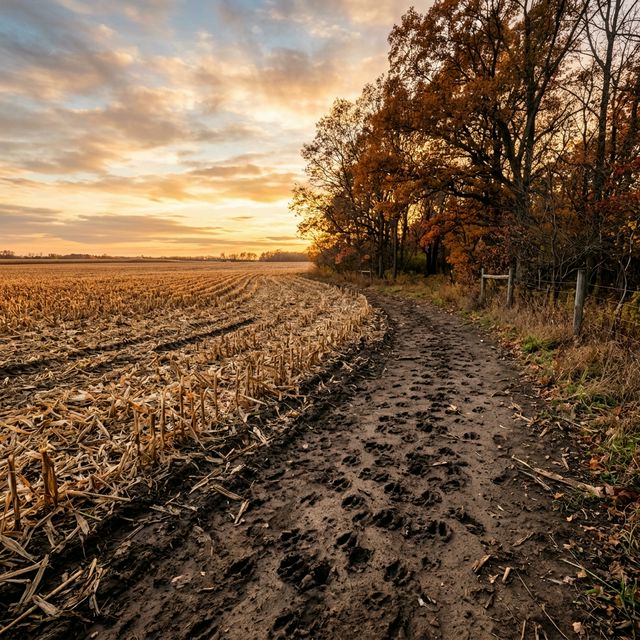
Agricultural Edges vs. Big Timber: Adapting Your Whitetail Strategy
Hunting a high-yield cornfield in the Midwest requires a vastly different approach than tracking a buck through the deep woods of the Northeast. Learn how to adapt your tactics for both radically different environments.
At Wildsnap, our team has collectively hunted everything from the high-density, heavily manicured soybean fields of Iowa to the infinite, trackless cedar swamps of northern Michigan. We’ve learned a fundamental, undeniable truth: a buck’s personality, his daily habits, and his survival strategies are a direct reflection of his environment.
A four-year-old buck living in the “Big Woods” behaves like an entirely different species than a four-year-old buck living on a 600-acre farm.
To be a consistently successful hunter regardless of where your truck is parked, you must perform a Nutritional Pivot—completely adapting your hunting logic from the “concentrated destination” of agricultural country to the “nomadic browse” strategy of the big timber.
Ag-Country: The High-Stakes Field Edge
In the farm country of the Midwest, the primary food source (corn, soybeans, or alfalfa) is incredibly dense and localized. It is a highly predictable Destination.
However, because the deer density is often exponentially higher in these areas, hunting the actual destination is a trap for amateur hunters.
1. The Staging Area Trap
Mature, veteran bucks almost never step directly into a wide-open cut cornfield during daylight hours. They survive by letting the younger bucks, fawns, and does enter the field first to act as an early-warning radar system.
- The Strategy: Instead of sitting directly on the field edge, you must hunt the “Staging Area.” This is typically a high-stem-count thicket or a small depression located 40 to 80 yards off the field edge inside the timber. The buck will leave his bed, travel to the staging area, and wait in the thick cover until full dark before entering the field. You must intercept him in the timber.
2. Sentry Avoidance
Because there are so many deer in ag-country, if you set up directly on the field edge, you run a massive risk of being “busted” (smelled or seen) by a paranoid, sub-dominant doe an hour before your target buck ever decides to move. Once a doe blows and stomps her hooves, the mature buck will simply turn around and go back to bed.
Big Timber: The Nomadic Quest
In the boundless, contiguous tracking snow of the “Big Woods” (found in states like Maine, northern Wisconsin, or the Adirondacks), there is no massive destination food source. There are no 100-acre soybean fields. There is only scattered, inconsistent Browse Diversity.
1. The Caloric-Burn Theory
Because the food is incredibly sparse, big timber bucks are inherently nomadic. They cannot afford to stand in one place. They may have to travel 3 to 5 miles a day in a massive, sweeping circuit just to find a single, recently dropped oak-flat or a fresh clear-cut.
- The Strategy: You absolutely cannot sit in a random tree and “wait for them to come to you”—they might not pass that specific tree for three weeks. You must actively find the Terrain Pinch Points (natural topographical funnels like ridgeline saddles, steep bluffs, and shallow creek-crossings) that dictate and condense their marathon travel routes.
2. The “Soft Edge” Strategy
While you can’t hunt a hard agricultural edge in the deep timber, you must hunt “soft edges.” A soft edge is a transition line in the forest where two slightly different habitats meet.
- Look for the line where an old, open pine plantation meets a dense, tangled cedar swamp.
- Look for an abandoned, overgrown logging road where sunlight reaches the ground, sparking the growth of low-level woody browse. These soft edges provide the exact 250 calories per hour of browse a mature buck desperately needs to survive the winter.
LANDSCAPE SAFETY: Farm Hazards vs. Wilderness Survival
Agricultural Hazards: Hunting active farm edges requires extreme caution regarding heavy machinery. Never set up a ground blind or park your truck near combining or tilling operations without the farmer’s explicit knowledge. The massive noise and dust of the machinery can completely mask your presence from the operator, leading to dangerous accidents.
Big Timber Hazards: In the deep woods, getting lost is a lethal reality, not an inconvenience. The landscape is visually monotonous for miles in every direction. Never enter big timber without a physical, battery-independent compass and a paper topographical map. Relying solely on a smartphone GPS is a fatal mistake when the battery dies in sub-zero temperatures. Furthermore, be hyper-alert for rusted, hidden “barbed-wire fencing” from homesteads abandoned 80 years ago; a single trip in the dark can lead to severe, tetanus-prone lacerations miles from help.
Whether you’re glassing a sprawling cornfield in Iowa or tracking massive hooves through a silent, snow-covered cedar swamp in Maine, the fundamental rules of whitetail hunting never change: rigorously play the wind, silence your approach, and learn the biology of your prey. Adapt your tactics to the specific environment, and the heavy bone will follow.