
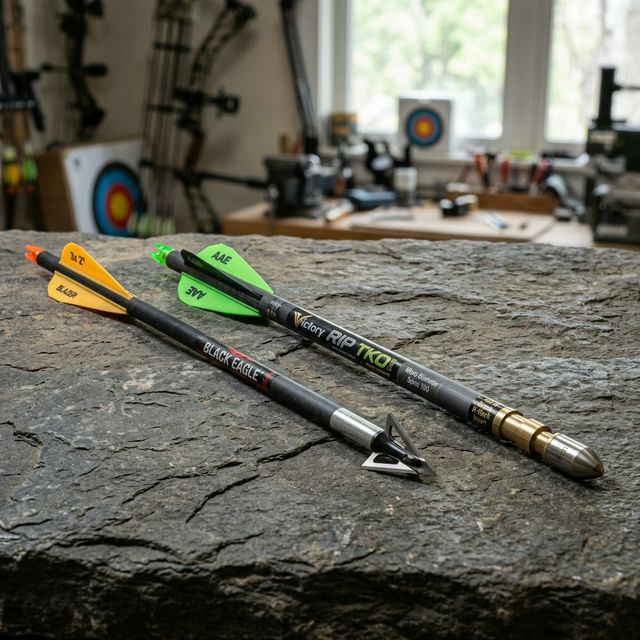
Heavy Arrows vs. Light Arrows: FOC, Momentum, and Lethality
The great archery debate definitively solved: Is raw speed better than bone-crushing penetration? We dive deep into the physics of arrow weight, kinetic energy, and Front of Center (FOC).
In the modern bowhunting community, no single topic generates more ferocious, impassioned debate than Total Arrow Weight.
Walk into any local archery pro shop, and you will immediately find the community violently split into two distinct, unyielding camps: the “Speed-Chasers” (who fetishize flat trajectories and incredibly light arrows) and the “Heavy-Holdouts” (who prioritize massive, bone-crushing momentum above all else).
At Wildsnap, our ideology is not based on emotion or brand loyalty; it is based exclusively on the undeniable physics of the Kinetic Energy vs. Momentum paradox. While a blistering fast, 380-grain arrow looks incredibly impressive on a foam 3D target or a chronograph at the range, a heavy, high-momentum arrow is what definitively secures the harvest when your shot hits the heavy shoulder blade of a 200-pound whitetail.
Here is exactly how to build a lethal hunting arrow.
1. The Physics: Kinetic Energy vs. Momentum
The entire debate is fundamentally rooted in a misunderstanding of physics.
- Kinetic Energy (KE): KE is heavily biased toward velocity. It represents the sheer energy the arrow carries in flight. A very light, incredibly fast arrow can generate massive Kinetic Energy.
- Momentum: Momentum, however, is massively biased toward mass. Momentum is the physical force that strictly dictates terminal penetration—how deep the object will push through physical resistance (hair, hide, muscle, and bone) before stopping.
If you throw a ping-pong ball at 100 MPH, it has high kinetic energy but zero momentum; it bounces off your chest. If you throw a 10-pound bowling ball at 10 MPH, it has lower kinetic energy but massive momentum; it knocks you over. In bowhunting, you want the bowling ball.
2. Choosing Your Total Weight (Grains)
When selecting a raw carbon shaft, you must look at the GPI (Grains Per Inch) rating and mathematically calculate your total build weight.
- The Light/Fast Build (Under 400 grains): These arrows provide a brilliantly flat trajectory out to 40 yards. This is incredibly useful for western hunters shooting long distances where a 3-yard rangefinding error results in a miss. However, the exact second this light arrow encounters heavy whitetail bone, it stops dead.
- The Heavy Build (450 - 550+ grains): This is the Wildsnap standard. A heavy arrow provides the unstoppable momentum required for a complete, double-lung pass-through. Furthermore, shooting a 500-grain arrow makes your actual bow significantly, noticeably quieter. A heavier object absorbs vastly more kinetic energy from the bowstrings, drastically reducing the loud, high-frequency vibration that causes deer to “jump the string.”
3. The FOC Factor: Front of Center Balance
Total weight is only half the equation; where that weight is located on the arrow is arguably more important. FOC (Front of Center) is the mathematical measurement of the arrow’s physical balance point.
- Steering Power: A standard arrow has an FOC of around 8%, meaning the balance point is almost dead center. We advocate for a High FOC (13% to 18% or higher) by running extreme heavy brass inserts (50 to 100 grains) hidden inside the front of the carbon shaft, directly behind the broadhead.
- The Lawn Dart Effect: A high-FOC arrow drastically shifts the balance point toward the broadhead. This forces the arrow to fly through the air exactly like a heavy lawn dart, actively pulling the lightweight fletchings behind it. This creates an incredibly stable flight path that is massively forgiving of high crosswinds and minor archer form flaws.
Helical Fletching
At Wildsnap, we aggressively pair high-FOC shafts with a strict 3-degree helical fletch. This aggressive angle literally forces the arrow to spin rapidly in flight (exactly like a rifled bullet). This gyroscopic spin perfectly stabilizes the massive fixed-blade broadhead on the front, ensuring it stays on a laser-straight target path from the moment you release the string through the moment of impact.
CARBON SAFETY: The Flex-Test Mandate
Modern carbon arrows are incredibly rigid and strong longitudinally, but they are massively prone to invisible, microscopic internal fracturing if they strike a hard object (like a buried rock, a tree, or even “slapping” another arrow on a tight target group).
- The Explosion Risk: You must aggressively perform a “Flex-Test” after every single shot. Grab both ends of the carbon arrow and bend it in an arc while holding it close to your ear. Listen closely for any faint crackling or popping sounds.
- The Danger: If you hear a “pop” or visually see a carbon splinter, the arrow’s structural integrity is completely compromised. If you attempt to fire a cracked carbon arrow from an 70-pound bow, the extreme force will cause the shaft to violently explode upon release, sending jagged carbon shrapnel directly through your bow hand and forearm. Never shoot a questionable shaft.
Raw speed and flat trajectory are impressive statistics, but terminal, bone-crushing performance is the sole ethical goal of a bowhunter. Build an arrow that sacrifices a bit of speed for massive, unstoppable momentum, and your short, massive blood trails will undoubtedly tell the story.