
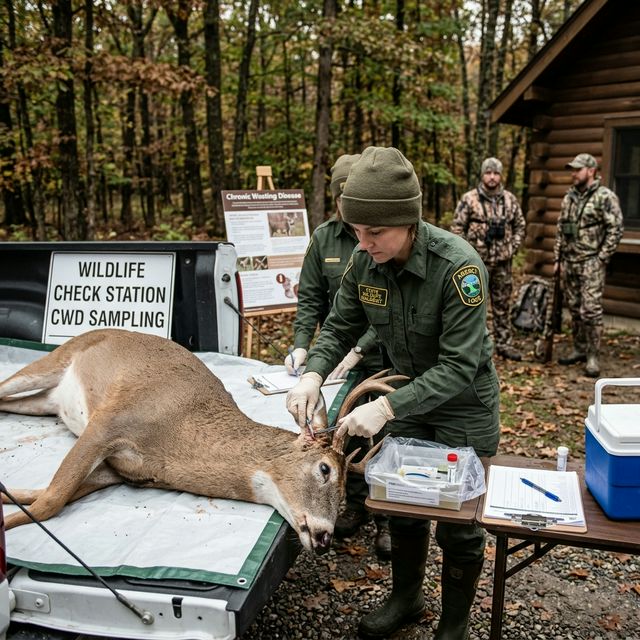
Chronic Wasting Disease (CWD): What Every Hunter Needs to Know
CWD is a fatal prion disease threatening whitetails. Learn symptoms, testing, carcass rules, field-dressing precautions, and how hunters slow the spread.
Chronic Wasting Disease (CWD) is the most serious long-term threat facing wild deer and the hunting traditions built around them. It is not a rumor and not a simple virus. CWD is a 100% fatal neurodegenerative disease caused by prions—misfolded proteins that can persist in the environment for years. Every hunter who field-dresses, transports, and processes deer is part of the containment system whether they intend to be or not.
Understanding the science makes the rules make sense.
What CWD Is—and What It Is Not
CWD belongs to the transmissible spongiform encephalopathy family, related in mechanism (not identical in host range) to diseases like scrapie in sheep. It is not caused by bacteria or conventional viruses.
Key facts hunters need:
- Always fatal once clinical disease develops; there is no cure or vaccine for free-ranging deer.
- Long incubation: An infected buck can look healthy for 18 to 24 months (sometimes longer) while shedding prions.
- Clinical signs late: Drooping ears, loss of fear, excessive salivation, stumbling, and extreme weight loss appear near the end—after the animal has already contaminated the landscape.
- Environmental persistence: Prions bind to soil particles and can remain infectious for years. Plants may also play a role in moving material in contaminated sites.
That timeline is why “he looked fine” is not proof of safety—and why testing programs matter even when your deer looks perfect.
How CWD Spreads Across the Landscape
Transmission occurs through direct contact and environmental contamination: saliva, urine, feces, and carcasses. High-density feeding and baiting sites can concentrate deer and amplify risk where regulations still allow those practices.
Practical implications:
- Carcass movement moves disease. Whole animals, brains, and spines shipped across county or state lines have historically helped CWD jump to new areas.
- Natural urine lures from unknown sources are a debated risk pathway. Many agencies and conservation groups urge synthetic-only scents to avoid moving bodily fluids between regions.
- Mineral sites and dirt licks in positive zones can become long-term contamination points because deer revisit the same soil. See the mineral caution in our antler growth biology article and follow local bans.
Trail cameras do not spread CWD, but the trails you create to check them can increase deer-human overlap if you dump bait. Keep camera sites clean and legal.
Symptoms Hunters Might Notice
Do not diagnose from a truck window—but do report and avoid consuming obviously sick animals.
Possible late-stage signs:
- Progressive weight loss despite available food
- Blank facial expression, drooping head or ears
- Excessive drooling or grinding teeth
- Repetitive walking patterns, lack of coordination
- Reduced fear of humans
Many infected deer show no obvious signs when harvested. That is why lymph-node testing exists.
Testing: Your Role in Surveillance
Hunters are the sampling network wildlife agencies rely on.
- Mandatory zones: If you kill a deer in a CWD management or surveillance area, you may be required to submit the head or specific tissues. Know the rules before you hunt.
- What labs need: Typically the retropharyngeal lymph nodes (and sometimes brainstem/obex tissue depending on the protocol). Agencies publish diagrams—follow them exactly.
- Turnaround: Results can take days to weeks. Freeze meat separately and wait if your agency advises holding consumption until results return.
- Voluntary testing: Even outside mandatory zones, voluntary submission helps map spread. Ask your state wildlife agency for drop-off locations.
Keep a cooler plan. A tested head and a clean, tagged carcass are part of modern ethical hunting in CWD country.
Field-Dressing and Processing Precautions
There is no confirmed case of CWD infecting humans, but public-health agencies including the CDC recommend a precautionary approach: do not eat meat from CWD-positive animals, and minimize contact with high-risk tissues.
In the field:
- Wear nitrile or latex gloves every time you dress a deer.
- Minimize handling of brain and spinal cord. Avoid sawing through the backbone or splitting the skull when possible.
- Do not cut through the spinal column to remove quarters if you can use joints instead.
- Bone out meat in the field or at a processor when transport rules require it.
- Dispose of carcass parts where rules allow—often approved landfills—not on another hunter’s favorite oak flat.
At home or camp:
- Use dedicated, non-porous cutting surfaces.
- If tools contact brain or spinal tissue, clean thoroughly; many guidelines recommend a 50% bleach solution soak (follow current agency guidance for concentration and time—commonly around one hour for contaminated tools).
- Do not render brain, spine, spleen, or lymph nodes into dog food or bone broth.
For broader meat handling after a clean kill, pair these rules with sound cooling practices in our meat spoilage limits and field dressing guides.
Transport Laws and Boning Out
Regulations change by state and sometimes by county. Common themes in CWD zones:
- No whole carcass export—only boned meat, quarters without spinal column, and cleaned skull plates or European mounts prepared to standard
- Mandatory check stations during peak seasons
- Restrictions on moving live deer, semen, and certain parts
Before you leave camp, read the current digest for every state on your trip. A DIY out-of-state hunt that ignores carcass rules can spread disease and earn citations. When in doubt, bone out and leave high-risk parts in the harvest area per instructions.
Processors should be certified or clearly following CWD protocols. Ask how they handle positive animals and whether your deer will be batched with others.
What Hunters Can Do Beyond Testing
Containment is slow work. Hunters still move the needle:
- Follow baiting and feeding bans designed to reduce congregation.
- Use synthetic attractants instead of natural urine products when agencies recommend it.
- Support agency sampling even when it is inconvenient.
- Report obviously sick deer with precise locations.
- Keep habitat work legal—hinge cutting and food plots are fine; illegal interstate carcass dumping is not.
Healthy herds need hunters who treat CWD as biology, not politics. Test, transport legally, and process cleanly so whitetails remain huntable for the next generation.
State Rules, Check Stations, and Trip Planning
CWD regulations change faster than most other deer laws. Before every season—and before every out-of-state trip—verify:
- Whether your hunt unit is inside a CWD zone, surveillance area, or disease management area
- Mandatory vs voluntary sampling and where to drop heads
- Carcass export rules for interstate travel and for moving between counties
- Baiting, feeding, and mineral restrictions tied to disease control
- Processor requirements and whether commercial processors in the area accept CWD-zone deer
DIY travelers should plan cooler space for boned meat and a legal disposal path for leftover parts. A freezer trailer full of intact carcasses may be illegal even if it feels convenient. When you book a processor, ask how they segregate animals and how they notify customers of positive tests.
Habitat and herd goals still matter in positive country. Healthy age structure, legal harvest, and reducing artificial congregation (bait piles, illegal dump sites) help agencies manage prevalence. Trail cameras remain useful for inventory without bait—pair them with careful access so you are not creating new feeding circuses. Pattern tools like WildSnap help you understand activity without pouring corn under every lens.
If a deer looks sick before you shoot, pass and report the location to your wildlife agency with GPS coordinates when possible. Surveillance depends on honest eyes in the field as much as lab capacity.
Hunters who process their own meat should keep CWD SOPs next to their field dressing checklist: gloves on, CNS avoided, tools cleaned, results checked before big family meals. That habit protects both your household and the credibility of hunting as a conservation tool.
Frequently Asked Questions
Can humans get CWD?
There are no confirmed human cases to date. Agencies still recommend against eating meat from CWD-positive deer and against exposing yourself unnecessarily to brain and spinal tissue.
Is it safe to eat a deer that looks healthy?
Appearance is not a reliable test. In surveillance zones, wait for official results when advised. Never eat an animal that tested positive.
Why are urine lures discouraged?
Natural urine can theoretically move prions between regions if collected from infected animals or contaminated facilities. Synthetic scents remove that pathway.
What parts carry the most prions?
Central nervous system tissue—brain and spinal cord—and certain lymphoid tissues carry the highest concentrations. Muscle meat is lower risk but is still not considered safe from positive animals.
Do I need to stop hunting in CWD areas?
No. Hunting and testing are part of management. Follow local rules, sample when required, and handle carcasses carefully so hunting remains a solution rather than a spread vector.