
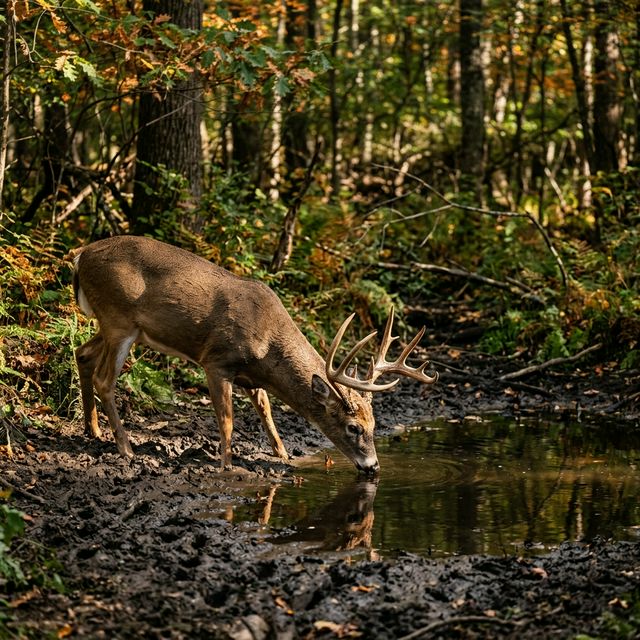
Hunting Over Water: When, Where, and How Whitetails Drink
Water is an absolutely essential but massively overlooked resource for deer hunters. Learn the biology of whitetail thirst and exactly how to tactically capitalize on hidden water holes during the hunting season.
While every casual deer hunter knows to blindly focus their entire season on obvious food plots and thick bedding areas, Secluded Water is the highly ignored, critical third leg of the absolute whitetail survival tripod.
At Wildsnap, our aggressive field tracking has definitively proven that a surgically well-timed sit directly over a highly secluded, hidden water hole is arguably one of the absolute most underrated, lethal tactics for consistently tagging a mature buck. This holds mathematically true specifically when the late-season mercury unexpectedly rises, or during the violent, frantic physical exertion of the November rut.
If you don’t know where the deer are drinking, you are only hunting half the property.
1. The Biology of Thirst: When Do Deer Actually Drink?
Many hunters mistakenly believe deer get all their required moisture purely from the green vegetation they consume. This is biologically false in the autumn.
As the frost kills the green, highly hydrated summer plants, the autumn woods rapidly transition to dry, hard mast (like incredibly dry acorns and dead corn). A healthy 200-pound whitetail physically needs to drink standing water one to two times per day just to digest this dry, fibrous food.
- The Rut Marathon: This daily requirement massively, violently spikes during the peak of the rut. A dominant buck aggressively chasing does across the county is essentially running a grueling physical marathon every single day while wearing a heavy winter coat. He loses massive amounts of moisture through heavy panting.
- The Midday Hydration: His desperate biological need for extreme hydration often powerfully overrides his ingrained nocturnal caution. Catching a completely exhausted, “rut-crazed” buck desperately slamming water at an isolated timber hole directly between 10:00 AM and 2:00 PM is a definitively proven, highly consistent winning strategy.
2. Identifying “Kill” Water vs. Just Water
You must understand that absolutely not all water on a property is a viable hunting destination. A massive 10-acre recreational lake or a wide-open cattle pond in a highly visible pasture is essentially useless for hunting mature deer during daylight.
Deer prioritize survival over convenience. They explicitly prefer:
- Extreme Seclusion: Mature bucks absolutely refuse to expose themselves to drink from the open bank of a massive pond. They fiercely prefer hidden, tight creek bends, tiny stagnant “cow holes,” or tiny logging ruts tucked incredibly deep in the heavy timber where they feel visually invisible.
- Muddy Integrity: Deer hate deep, treacherous muck. They actively seek out shallow, highly firm sandy banks where they can quickly drink without physically sinking to their chest in the mud.
- The “Safety Stop” Setup: The absolute most lethal water hole is one located exactly in a micro-transition zone directly between a known, thick bedding area and the primary evening food source. They hit the water for a quick, 30-second drink immediately after standing up from their bed before heading to the fields.
3. The Tactical Challenge: Thermal Pooling
Secluded water holes are almost always located in the absolute lowest geographical elevation points on the property (deep ravines, creek bottoms, or swamp bowls). This specific topography actively creates a massive, infuriating challenge for the hunter: Violent Thermal Pooling.
- The Scent Trap: As the sun goes down in the late afternoon, the rapidly cooling, heavy air forcefully falls directly down into these dark, low spots, carrying your overwhelming human scent straight down from your tree stand and directly onto the water’s surface.
- The Solution: You absolutely must position your tree stand on the hillside slightly uphill from the water, or heavily utilize a high-elevation “hang and hunt” saddle setup that physically keeps your body mathematically higher than the rapidly pooling cold air, completely avoiding getting instantly “busted” by the swirling wind in the bottom.
HABITAT MANAGEMENT: Creating Your Own “Kill Hole”
If your specific 40-acre property is high and dry and completely lacks natural water, you can aggressively manufacture a massive tactical advantage.
- The Stock Tank: Burying a heavy-duty, black 100-gallon plastic agricultural stock tank flush with the ground in a strategic staging area is the absolute gold standard for habitat manipulation.
- The Fill Protocol: You must be hyper-paranoid about human scent. We heavily mandate wearing knee-high rubber boots and sterile surgical gloves when manually filling the tank with jugs. If a mature buck smells human sweat violently radiating from the plastic rim of the tank, he will permanently associate your exact scent with the water source and completely abandon it.
- The Crucial Escape Ramp: You absolutely must permanently place a large, heavy oak branch directly into the center of the tank to allow small squirrels, mice, and birds to climb out. Absolutely nothing ruins a strategic water hole faster than the putrid, bacteria-riddled decaying carcass of a raccoon rotting in the drinking water.
Do not ever blindly overlook the massive, biological power of deep hydration. On a violently hot October afternoon or in the chaotic middle of the November rut, a tiny, secluded mud hole isn’t just a place for a deer to get a drink—it’s mathematically the absolute most likely spot on the entire farm to cross paths with a giant.