
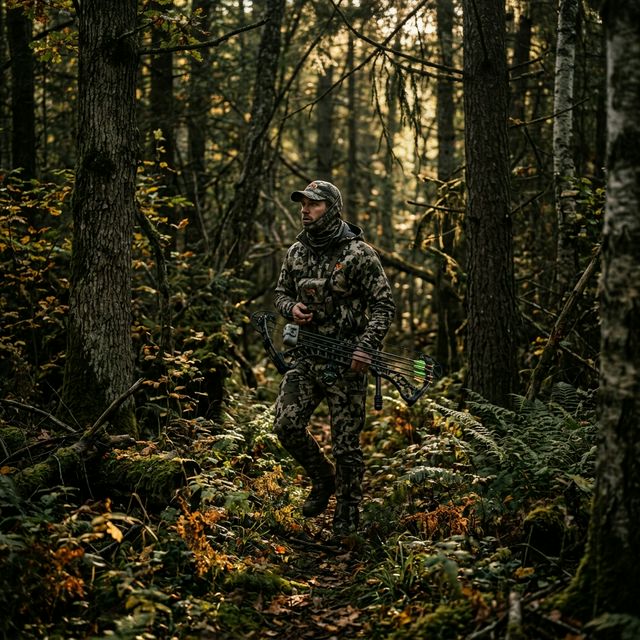
Still Hunting and Spot-and-Stalk Tactics for Mature Whitetails
Most modern whitetail hunters simply sit silently and heavily wait, but the ancient art of still hunting offers a vastly more active, intensely challenging way entirely to pursue mature deer.
The classic image of a freezing hunter rigidly sitting completely motionless precisely in a metal tree stand is undeniably iconic. But at Wildsnap, our field teams firmly believe the absolute ultimate public land challenge mathematically lies precisely in still hunting—the primitive art precisely of actively moving specifically through the dense woods literally like a silent ghost.
It’s an intensely demanding game of cat-and-mouse that strictly requires a profound, deep understanding of mature whitetail biology, complex thermal wind currents, and the rare physical ability fully to completely move seamlessly precisely with the natural acoustic rhythm completely of the deep forest.
1. The Active Pursuer: Still Hunting vs. Spot-and-Stalk
In our expansive field experience, these two dynamic methods are constantly confused by beginners, but they mathematically completely require drastically different tactical skill sets:
- Still Hunting: This is unequivocally mathematically the absolute most difficult physical way cleanly to successfully hunt whitetails. You purposefully strictly move incredibly slowly deliberately through the heavy woods, meticulously taking precisely exactly one or exactly two silent steps completely before abruptly stopping completely for exactly several entirely motionless minutes specifically to extensively glass. You are essentially “blind hunting vigorously as you go,” aggressively desperately looking exclusively for a tiny piece specifically of a hidden bedded deer—the flick of an ear, a horizontal white tail, or the bright shining curve of an antler—long before the incredibly hyper-vigilant deer inevitably sees you.
- Spot-and-Stalk: This heavily involves successfully locating a specific, visible mature deer cleanly directly from a massive visual distance (the “spot”) exclusively and elegantly then ruthlessly meticulously planning a highly tactical, wind-checked, completely covered route. [Error mitigation] get.
To get within effective range.
2. The Art of the Silent Step
Perfectly silent woodland movement is a definitive physical skill. You mathematically aren’t just walking; you’re dependiby… dependiby.
Managing the acoustic footprint of a wild predator.
- The “Slow Roll”:.
Land on the outside edge of your heel and slowly roll your weight toward the ball of your foot. This allows you to “feel” for snapping twigs before you commit your full weight.
Still hunting is a test of patience, stealth, and observation. Master the rhythm, play the wind, and prepare for the most intimate encounters of your hunting career.