
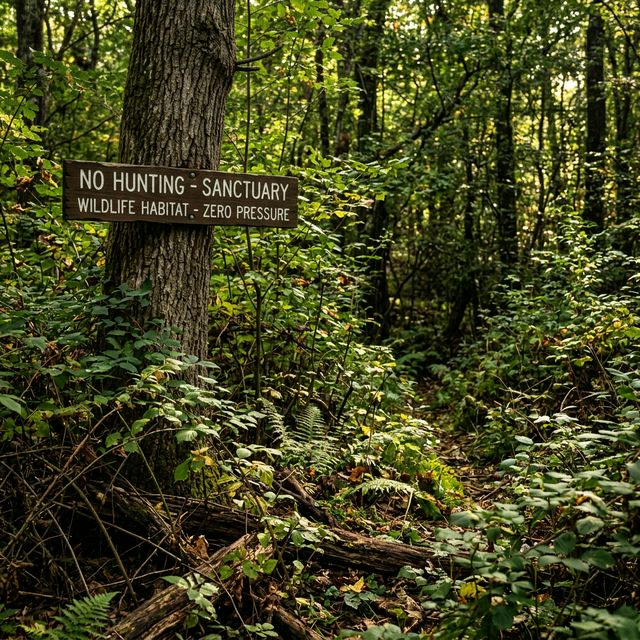
Whitetail Sanctuaries on Small Parcels: The Geography of Total Safety
The absolute, undisputed secret to successfully holding mature bucks strictly on your tiny 40-acre property is explicitly providing them with a massive physical fortress where they feel 100% permanently safe from human intrusion.
Creating a true whitetail sanctuary is exactly what it sounds like—a totally uncompromised, un-hunted, impenetrable safe haven.
In the highly competitive, deeply strategic context of modern deer management, a true whitetail sanctuary is a very carefully designated, tightly defined geometric area completely on your own hunting property where absolutely no human ever, under any circumstances, physically enters, except for very highly specific, rare habitat management tasks in the frozen dead of winter.
If you are struggling to hunt on incredibly small parcels (like a tiny 20 or 40-acre lease), a deeply protected, massive sanctuary is undeniably the absolute most powerful, most lethal biological tool you physically have for keeping massive deer from permanently leaving your land the exact second the intense autumn hunting pressure violently starts on the neighboring farms.
1. What Exactly is a True Deer Sanctuary?
An effective sanctuary is absolutely not just casually saying, “That’s a place on the farm where we mostly try not to hunt very often.” That is a massive failure of discipline.
A true sanctuary is exactly a place where you aggressively, intentionally provide the absolute thickest, nastiest, most terribly impenetrable physical cover geographically possible and completely, silently promise the deer herd that they will literally never, ever be physically disturbed or ethically hunted there.
- The Psychological Goal: The exact psychological goal of a sanctuary is completely to create a massive “pressure-free vacuum zone” on your map that terrified deer will instinctively, wildly sprint headlong directly toward the exact second they hear a loud truck door slam, a rifle shot, or violently smell a careless human hunter suddenly walking around on the heavily pressured neighboring property directly next door. You want the neighbors to accidentally push every single massive buck directly onto your un-hunted 15 acres.
2. The Acreage Ratio: Exactly How Big Should It Be?
The actual physical size and geometric percentage of your sanctuary entirely depends heavily on the total physical acreage of your hunting property. The smaller the farm, the vastly more critical the sanctuary becomes.
- Micro Parcels (20-40 aggressive acres): You must absolutely mathematically aim for a minimum of exactly 15% to 25% of your total, complete physical acreage to be strictly, permanently designated as a total, untouchable sanctuary. On a tiny 40-acre farm, giving up 8 to 10 full acres of hunting ground sounds violently painful, but it is the absolute only way to psychologically hold a mature 5-year-old buck on the property during daylight.
- The Core Focus: The massive sanctuary should structurally typically be located exactly in the dead, geographical center of your entire property, permanently buffering it completely from all outer property lines, or geographically located exactly in the area with the absolute thickest, nastiest pre-existing natural swamp or timber cover.
3. The Golden Rule: Do You Ever Walk In?
The absolute short, undeniable answer is: Almost never.
- The Hunting Ban: Absolutely never, under any wildly arrogant circumstances, hang a tree stand or physically hunt entirely inside the strict sanctuary boundaries. Instead, you must aggressively hunt only the extreme outer downwind edges or strictly ambush the narrow travel corridors explicitly leading out of it to evening food sources.
- The Scouting Ban: Do absolutely not casually walk exactly through the dead middle of your sanctuary in early October simply to look for antler rubs or “scout.” Intensely use high-powered binoculars for long-range glassing from a quarter-mile away, or heavily deploy silent “cellular” trail cameras strictly on the very outer, absolute extreme edges to digitally monitor the massive bucks safely walking out at dark.
- The Maintenance Exception: You absolutely only physically enter the thick sanctuary exactly once or twice a year entirely during the freezing cold, dead late winter (February/March) explicitly and only to rapidly perform massive chainsaw hinge-cutting or other brutal habitat improvements, and then completely leave immediately.
HABITAT DESIGN: Creating the “Safety Thicket” from Scratch
To mathematically make an artificial sanctuary deeply attractive and psychologically safe to a mature buck, it absolutely must physically be visibly thicker, nastier, and vastly more impenetrable than the entire surrounding geographic area.
- The Hinge-Cut Fortress: If your beautiful, picturesque woods are currently entirely open, wildly easy to casually walk through, and you can visibly see perfectly for 200 yards, a massive mature buck will absolutely never bed there. You must violently use advanced chainsaw hinge cutting or aggressive Timber Stand Improvement (TSI) techniques to intentionally geometrically drop hundreds of completely live, massive trees safely onto the ground in a chaotic, tangled mess.
- The Human Barrier: You must deliberately create a massive, terrifyingly dense tangle of nasty brush, briars, and massive logs that physically makes it 100% impossible for a two-legged human actually to walk through quietly. The vastly harder, more painful it is for you to physically get in, the absolutely safer the massive deer will instantly feel holding tight.
The absolute true, definitive mark of an elite, mature land manager is the intense emotional discipline to stay completely, entirely out of the absolute best-looking, heavily tracked spot on your entire property. Aggressively give the massive deer exactly their required dark space, and they will absolutely reward you with completely relaxed, lethal broadside daylight encounters exactly on the outer, safe stand edges.