
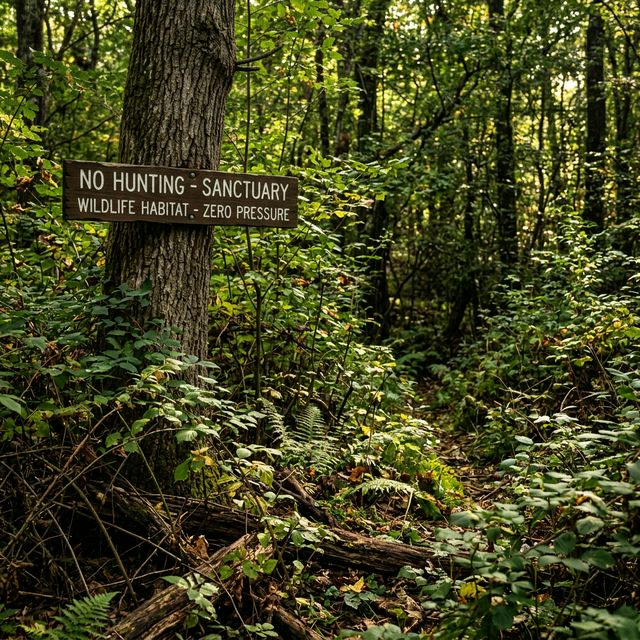
Whitetail Sanctuaries on Small Parcels: The Geography of Total Safety
Build a true whitetail sanctuary on 20-40 acres: size ratios, hinge-cut cover, zero-entry rules, and edge setups that hold mature bucks tight.
A whitetail sanctuary is a defined block of cover where humans almost never enter—except rare winter habitat work. It is not “the spot we try not to hunt much.” Soft rules fail the first exciting October morning.
On small parcels (20 to 40 acres), a real sanctuary is often the best tool for holding mature bucks when neighbors start pounding their edges. Give deer a pressure-free core, and they will use your ground as a refuge when trucks slam doors next door.
What Makes a Sanctuary Real
A sanctuary needs three things: thick cover, clear boundaries, and discipline.
- Cover: Nastier than anything around it—briars, hinge-cuts, saplings, swamp edges.
- Boundaries: Marked on the map and understood by every hunter on the lease.
- Rules: No stands inside. No October “just looking for rubs.” No shed sweeps in the core.
The psychological goal is a vacuum. When pressure hits adjoining land, deer sprint toward the one place they have learned is quiet.
How Big Should the Sanctuary Be?
Smaller farms need a higher percentage of protected ground.
- 20–40 acres: Aim for 15% to 25% untouchable. On 40 acres, that is roughly 6 to 10 acres.
- 80–160 acres: 20% still works; you can protect a larger core and still have multiple hunt edges.
- Shape: Prefer one solid block over scattered postage stamps deer cannot trust.
Place the core in the thickest existing cover—often the center of the property or a swamp/briar pocket buffered from boundary lines. Hunting the fence line every wind only educates deer to leave.
Sanctuary thinking scales up on leases too—see managing hunter pressure on a lease.
The Golden Rule: Almost Never Walk In
Short answer: almost never.
- No hunting inside the boundary. Hunt downwind edges and trails leaving toward food.
- No casual scouting through the middle in fall. Glass from afar; put cameras on outer edges only.
- Maintenance window: Enter once or twice in late winter (February–March) for hinge-cutting or TSI, then leave.
If you cannot resist the best-looking thicket on the farm, you do not have a sanctuary—you have a wish.
Building Cover With Hinge-Cuts and TSI
Open park timber will not hold a daylight buck. Create a thicket:
- Hinge-cut low-value trees to waist/chest height so crowns stay alive and create horizontal cover.
- Drop enough stems that a human cannot stroll through quietly.
- Leave travel seams on the edges you plan to hunt—do not maze yourself out of shot opportunities.
- Protect preferred oaks and mast trees outside the densest tangle.
For technique detail, use timber stand improvement and hinge-cutting. Pair new cover with bedding-area concepts so you understand why bucks pick your fortress.
Hunting the Edges Without Burning the Core
Sanctuaries pay when you ambush the exit—not the bedroom.
- Hang on the downwind fringe 30 to 80 yards outside the boundary.
- Focus on evening trails toward ag, plots, or oak flats.
- Morning sits work when you can enter without cutting the sanctuary wind.
- Limit sits: two quality evenings per week on a hot edge beats five lazy ones.
- After a shot, plan recovery routes that skirt the core when possible.
Mobile hunters can use saddle hunting to pick edge trees without leaving permanent steel inside the buffer.
Camera and Scout Protocol
- Cameras on edge scrapes, trails, and corners—not deep inside.
- Check SD cameras during midday on rainy days, or use cellular to stay out.
- Review for daylight trends before you hang.
- If a target buck beds inside, do not “bump verify.” Trust edge data.
Mistakes That Destroy Sanctuaries
- Shrinking the boundary every time a big rub shows up inside
- Letting guests “just take a walk” through the core
- Running ATVs along the sanctuary edge at dawn
- Planting a food plot in the middle of the only bedding thicket
- Hunting the same edge on the wrong wind and tagging the core with scent
- Shed hunting the fortress in February while bucks still use it
Small-Parcel Sanctuary Checklist
- Core drawn on map and shared with all hunters
- 15–25% acreage protected on micro farms
- Cover thicker than neighboring ground
- Edge stands only; wind rules written down
- Camera plan that never requires core entry in season
- Winter-only habitat work scheduled
On tiny farms, also study small woodlot strategies—sanctuary plus access discipline is usually the whole game.
Designing Edges Deer Will Use in Daylight
A sanctuary only pays if deer leave it on trails you can hunt:
- Create or enhance two to four exit corridors toward evening food using light hinge work outside the core.
- Keep staging browse (soft mast, shrubs) just outside the boundary so bucks linger at last light.
- Avoid putting the primary food plot so close that you bump the core every time you check cameras.
- On 20-acre farms, one excellent edge stand with two wind options beats four mediocre setups.
- Log every sit: wind, thermal notes, deer seen, and whether scent may have tagged the core.
Neighbor Pressure as an Asset
Talk—politely—with adjoining landowners when possible. If they hunt opening weekend hard, your sanctuary becomes the release valve. If they also protect cover, you may share a larger unofficial refuge and need even stricter edge discipline.
When neighbors drive deer, sit the fringe that same morning if wind allows. Refuge shifts happen in minutes after the first volley of shots. Have a stand pre-hung for that scenario instead of improvising under adrenaline.
Field Notes and Practical Numbers Use these benchmarks to keep decisions concrete rather than vague:
- Log every sit with date, wind direction, temperature, and deer observations—patterns appear after 8 to 12 recorded hunts on the same property.
- Limit first-time pressure on a hot pin to one quality sit, then rest at least 24 to 48 hours unless the rut calendar demands otherwise.
- Carry a short checklist in your phone notes so gear and safety steps do not depend on memory at 4:30 a.m.
- Revisit your plan weekly during the season; crops, pressure, and breeding phases change the right answer.
- When in doubt, choose the option that leaves mature deer less educated for the next sit—longevity beats one burned encounter.
These habits compound across a season and across years on the same ground.
Successful hunters treat preparation as part of the hunt itself. Write down what worked, what failed, and what you will change next time. Small improvements in access, timing, and patience usually matter more than buying another gadget. Stay flexible after weather swings, keep safety non-negotiable, and measure success by clean opportunities and ethical recoveries—not only by antlers on the wall. Over a full season, disciplined routines outperform random hard hunting.
Year-One Timeline for a New Sanctuary Month-by-month discipline beats a vague promise:
- February–March: Mark boundaries, hinge-cut the core, exit immediately.
- April–June: Stay out; let cover leaf out. Cameras only on edges.
- July–August: Glass food from afar; do not “inspect” beds.
- September–January: Hunt edges only; enforce guest rules.
- Next February: Light maintenance if needed, then seal it again.
After one full season of real abstinence, daylight edge encounters usually climb. If they do not, your cover may still be too open—or neighbors may be quieter than you thought, reducing the refuge effect.
Frequently Asked Questions
Can I hunt the sanctuary if I see a giant step out at noon?
Not if you want the system to work next week. Hang on the edge he must use later, or wait for a wind that lets you sit the fringe.
Should sanctuaries include food plots?
Usually no. Food belongs outside so deer leave cover on predictable trails. A tiny browse opening inside is different from a destination plot that invites weekly human traffic.
How soon do deer start trusting a new sanctuary?
Often within one season if you truly stay out. Heavy hinge-cut cover can attract use the first fall.
What if my only thick cover is on the property line?
Protect what you can and minimize boundary walks. A thin line sanctuary is weaker but still better than zero refuge.
Do cellular cameras inside break the rules?
They reduce foot traffic, but installing and fixing them still means entry. Edge cameras are the cleaner compromise on small acreage.
Elite managers leave the prettiest thicket alone. Protect that dark core, hunt the edges with wind discipline, and small parcels can punch far above their acreage when the neighborhood gets loud.
Wildsnap • Open beta
Join Wildsnap and try the beta
In the open beta, you turn trail-cam data into actionable insights—free, fast, and simple.
No credit card