
How to Create a Master-Class Mock Rub Line
Build a realistic mock rub line to pull cruising bucks past your stand. Tree choice, spacing, gland lures, kill-lane pauses, and safe bark-shredding tools.
Bucks advertise dominance with tree rubs—visual and scent signposts that spike as velvet sheds and testosterone rises. Most hunters only hope to find a natural line. You can also build one: a mock rub line that steers a cruising buck along a path ending broadside in your lane.
This is not magic. It works best in October–early November near real travel, with realistic trees, spacing, and scent. Done poorly, it looks like vandalism and gets ignored. The difference between a line that pulls a 3-year-old buck off a parallel trail and one that educates every deer on the ridge comes down to placement, species choice, and restraint.
Single Rubs vs a True Rub Line
One shredded sapling in random timber is a curiosity. A line of rubs every 15–20 yards along a quiet corridor reads like a rival on patrol.
Use mock lines to:
- Pull bucks off a parallel trail 30–40 yards away
- Steer traffic past a predetermined shooting lane
- Create a final “stop” tree for a stationary shot
Do not build them across primary bedding interiors you cannot hunt without blowing the sanctuary. Guide travel on the fringes. A mock line through the heart of a doe bedding thicket might attract camera photos at midnight, but you will never hunt it without spooking the entire pocket on entry.
The best mock lines connect two real features: an existing rub route, a staging scrape cluster, or a funnel between two bedding zones. Bucks already use the corridor; your line adds a reason to pause where you can shoot.
Pair visual sign with scent hubs via mock scrapes as communication hubs and scrape hunting strategies.
Planning the Line Before You Touch a Tree
Walk the corridor twice before you bring a rasp. First pass: note natural rubs, scrapes, and trail width. Second pass: identify wind for your intended hunt dates and mark where a buck would naturally pause to investigate sign.
Sketch a simple map on your phone or a notepad:
| Step | Action |
|---|---|
| 1 | Locate the parallel trail or funnel you want to intercept |
| 2 | Mark 4–8 candidate trees along that route, spaced 15–20 yards |
| 3 | Confirm the last tree sits in your clearest shooting lane |
| 4 | Verify your entry route never crosses the line downwind |
If the corridor already has three or four natural rubs from last season, refresh those first and add only what is needed to complete the visual tunnel. Overbuilding is the fastest way to make a mock line look like human vandalism rather than rival sign.
Trail cameras placed 15–20 yards off the line at the stop tree will tell you within a week whether bucks are investigating or avoiding. Check them on low-pressure days and wear gloves when swapping cards.
Tree Selection and Spacing
Choose soft-barked aromatics roughly calf-diameter:
- Cedar
- White pine
- Willow
- Soft maples / similar saplings where legal and abundant
Fresh cambium on these species smells “right” when shredded. Giant oaks are hard to work and look unnatural as mock rubs. A 4-inch cedar sapling with vertical shreds at chest height reads authentic; a 24-inch oak with knife marks at knee height reads like a landscaping mistake.
Spacing: Refresh or create a visible rub about every 15–20 yards so a buck investigating one tree sees the pale wood of the next. That visual tunnel encourages follow-through. On tight creek-bottom corridors, 12-yard spacing can work. On open hardwood benches, stretch to 25 yards but never beyond visual contact between trees.
Work with an existing subtle trail—not a brand-new highway carved through switchgrass with no prior use. If deer are not already traveling within 40 yards of your planned line, no amount of shredded bark will invent traffic.
How to Make Rubs Look Real
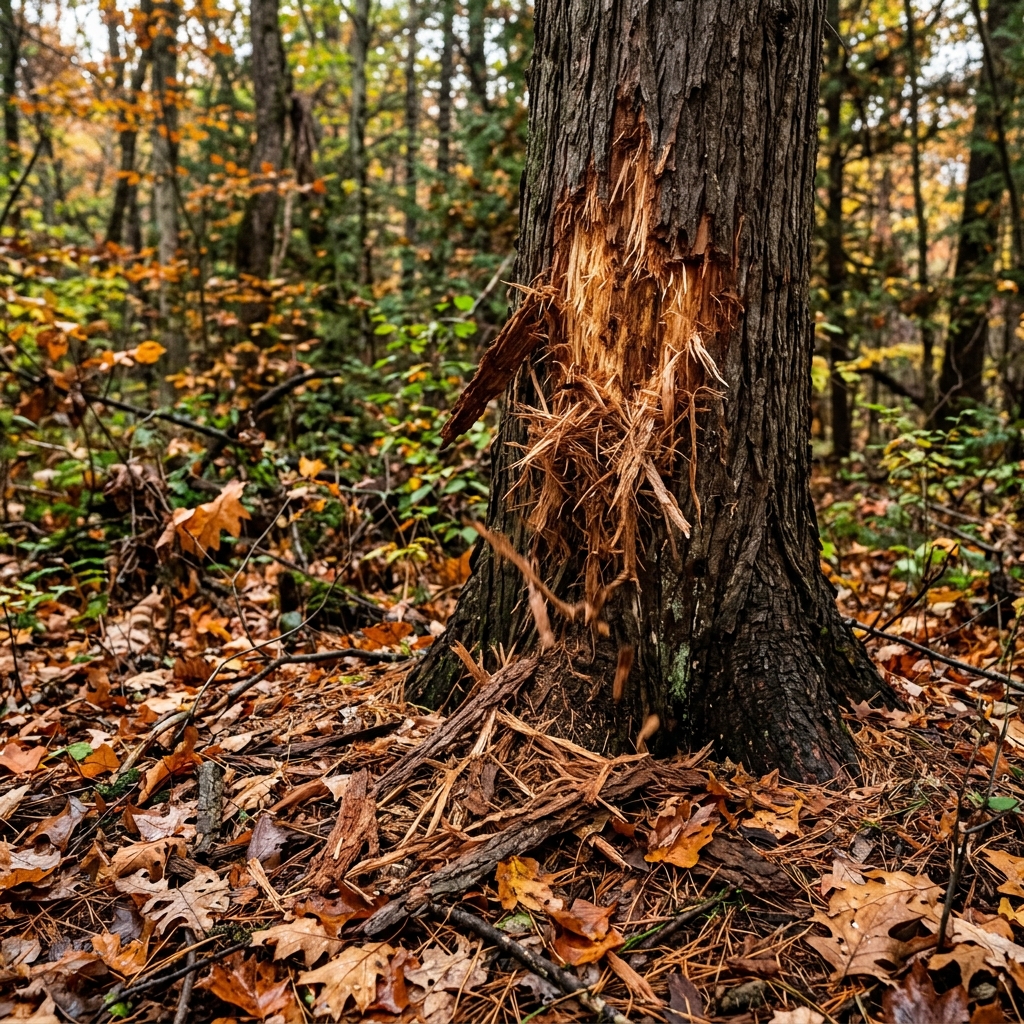
Real rubs show fibrous shreds, height matching a buck’s head/chest, and sometimes mud or hair. Aim for that.
Technique tips:
- Shred bark in vertical strokes at realistic height (often ~2–4 feet depending on terrain and deer size)
- Expose bright wood without girdling every stem on the property
- Face the bright side toward the approach you want the buck to use
- Avoid perfectly identical marks; vary intensity slightly along the line
- Leave a few small branches attached on some trees—real rubs often break twigs at the contact zone
Height matters more than hunters realize. On flat ground, most rubs cluster between 30 and 48 inches. On a hillside where the buck stands below the tree, marks may appear higher. Match the terrain, not a textbook average.
Tool safety: Skip the hunting knife. Blades slip on wet bark and cause deep cuts. Use a coarse wood rasp or stiff wire brush with two-handed control. Safer and often more realistic fiber tear. Some hunters attach shed antler tines to a short handle for thrashing—effective, but control your strokes so you do not snap every sapling.
Wear rubber gloves and scent-free outer layers. Human hand oils on fresh cambium can linger for days and spook cautious bucks.
Scent: Selling the Rival Story
Eyes get attention; forehead/preorbital scent sells ownership.
After shredding, apply a quality forehead gland or dominant-buck scent to damp wood. Real bucks grind waxy gland oils into fibers—your lure mimics that challenge.
Guidelines from deer lures:
- Use sparingly; puddles smell fake
- Wear gloves; keep human scent off the line
- Refresh after heavy rain if you will hunt the set soon
- Check local rules—some areas restrict scents or mock setups near bait bans
A dime-sized smear at the contact zone beats a soaked rag every time. Apply at dusk when you leave the area so the scent settles overnight without your body odor attached.
Cameras often show bucks lingering minutes on a convincing mock rub during seeking phase. That pause is the point. Pre-rut timing aligns with hunting the pre-rut seeking phase—build your line 1–3 weeks before you plan to hunt it so sign looks established rather than fresh-cut.
The Kill-Lane “Stop” Rub
The last rub matters most. Place the biggest, freshest mock rub in your clearest shooting lane at known yardage (18–25 yards for most bow sets).
When a buck works the line, he hits that tree and stops to smell/lick/shred. You get a quartering-away or broadside freeze without desperate mouth grunts that can spook him.
Layout checklist:
- Entry route that never crosses the rub line
- Wind blowing into dead space, not down the line into his nose as he approaches
- One primary lane centered on the stop tree
- Backup lane for the buck that skirts 10 yards wide
The stop tree should be the most visually obvious rub on the line—slightly larger diameter, fresher pale wood, and the strongest scent application. Bucks often work it longest because it reads as the newest challenge from the rival buck they have been following.
If you run a mock scrape 8–12 yards from the stop rub, you create a two-part communication hub. The buck may circle between rub and scrape, giving you extra seconds to settle a pin or scope. Keep the cluster simple—one rub, one scrape, one shooting lane. A maze of sign in tight cover educates deer without giving you a shot.
When Mock Rub Lines Work Best
| Period | Effectiveness | Notes |
|---|---|---|
| Early Sept | Low–moderate | Territorial but food-focused |
| Oct / pre-rut | High | Seeking bucks investigate rivals |
| Peak chasing | Moderate | Bucks locked on does may ignore |
| Post-rut | Low | Energy conservation mode |
Build lines 1–3 weeks before you plan to hunt them so scent and visuals settle into the “neighborhood news.” Hunting the afternoon you build can work but often educates if wind is wrong.
Morning hunts on mock lines rarely outperform afternoons during the pre-rut. Cruising bucks investigate sign during daylight transition periods—last two hours of daylight and the first hour after sunrise when they move between bedding and feed. Match your sits to camera timestamps, not guesswork.
On small properties (under 80 acres), one well-placed 5-tree line beats three scattered rubs across the farm. Concentrated sign in a huntable corridor with correct wind beats volume every time.
Common Mistakes
- Rubbing every tree in a 5-acre block (looks unnatural; harms cover)
- Building in a dead-calm bowl with swirling wind
- Using food attractants under rubs in banned counties
- Checking the line daily on foot
- Expecting midnight camera bucks to show at noon without wind/match timing
- Placing the stop rub beyond your comfortable shooting range
- Ignoring parallel trails—if the buck’s established route is 60 yards away, your line may never intercept
Mock lines amplify existing movement. They rarely invent a buck that has no reason to be in that creek drainage. Scent control on entry remains non-negotiable—see whitetail scent control for the full approach.
Frequently Asked Questions
How many rubs should a mock line include? Often 4–8 trees over 60–120 yards is enough. Longer lines help on big timber travel routes; short lines work on tight funnels.
Will mock rubs scare deer? Poor, human-scented work can. Realistic height, right species, gloves, and light scent usually get investigated, not avoided.
Can I use real shed antlers to thrash trees? Yes—some hunters prefer it for realism. Control strokes so you do not snap every sapling. A rasp still wins for safety and consistency.
Should I combine mock rubs and mock scrapes? Often yes: a scrape near the stop rub creates a communication hub. Keep the cluster huntable with wind, not a maze of sign in bedding.
Is this ethical on public land? Follow all cutting/damage rules. Many public areas prohibit cutting live trees. When in doubt, only work dead/down material or skip mock rubs entirely.
How often should I refresh? Before key sits after heavy rain, or weekly in peak seeking if pressure stays low. Less is more on small properties.
Take control of the visual and scent story on a corridor you can hunt. A disciplined mock rub line turns random cruising into a choreographed pause in your lane.
Confirm seasonal patterns from your cameras
Find patterns and time your hunts right when your camera history tells you what happened — and when.
No credit card
Wildsnap • Open beta
Confirm seasonal patterns from your cameras
Find patterns and time your hunts right when your camera history tells you what happened — and when.
No credit card