
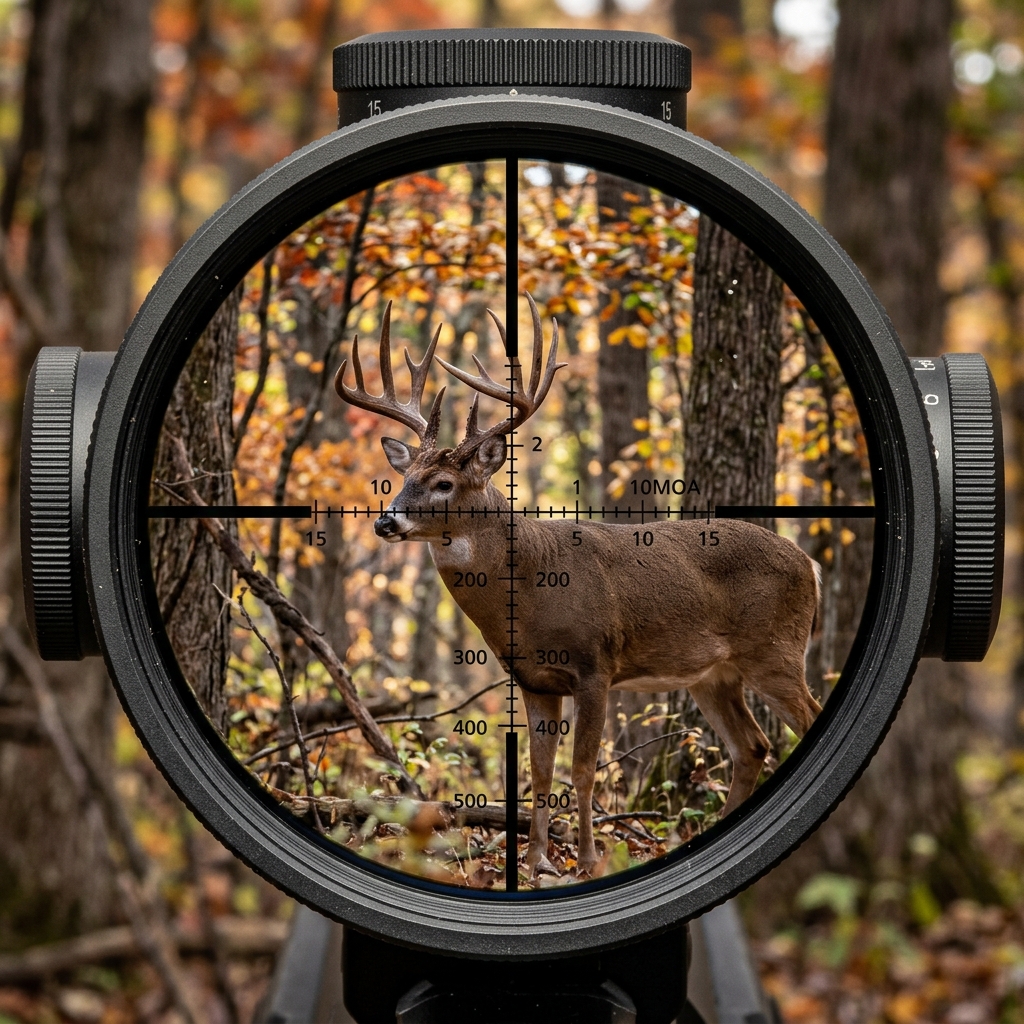
Rifle Scopes for Deer Hunting: Magnification and Precision Reticles Explained
Pick deer-hunting glass with the right magnification, reticle, focal plane, and coatings. 3-9x baselines, illumination, FFP vs SFP, and low-light tips.
Spend thoughtfully on the optic that connects your eye to the target. A rifle scope will not replace wind reading or shot discipline—but poor glass loses animals at dawn and dusk when mature bucks finally step out and legal shooting light is measured in minutes, not hours.
Here is a practical framework for whitetail magnification, reticles, focal planes, and features that matter in timber and fields—not catalog specs written for long-range bench shooters who never climb a tree stand.
Best Magnification Ranges for Whitetails
For most North American timber and mixed farm hunters, a 3-9×40 (or similar 2-7× or 2.5-10×) remains the workhorse optic decade after decade.
Magnification breakdown by use:
- Low end (2–3×): Wide field of view for brush, moving deer, and close shots under 75 yards
- Mid range (4–6×): Everyday sitting power for 50–200 yards across food plots and cutovers
- Top end (9–12×): Enough for most ag-field shots without turning the scope into a dark tunnel at low power
If 90% of your ethical shots are under 100 yards in timber, a heavy 4-16× or 5-25× is usually the wrong tool. You will struggle to find deer quickly in the glass, fight eye relief at max power from awkward stand angles, and add weight you do not need on a climb.
Long-field specialists who regularly shoot past 250 yards across open crops may prefer 4-12× or 3-15× with a simpler duplex or BDC reticle—still practice at realistic distances from field positions, not just benchrest. Caliber and recoil pairing ideas: best rifle calibers for whitetail.
Variable scopes with a true 2× or 2.5× bottom end outperform fixed-power glass in thick cover where a buck appears at 40 yards and you have three seconds to settle the reticle. Keep the power low until you confirm range.
Objective Size, Weight, and Mounting
Larger objectives (40–50mm) gather more light but need higher rings, add bulk on a climbing rifle, and can snag branches on a still-hunt through thick cover.
Practical balance:
- 40mm: Versatile, lighter, easier pack gun; adequate for 95% of whitetail hunters
- 44–50mm: Modest low-light edge if quality coatings exist—cheap large bells do not equal premium glass
- 56mm and up: Specialized low-light or long-range; rarely necessary for typical deer camp rifles
Mount with solid rings and bases, correct eye relief, and a level reticle. A canted reticle at 200 yards invents horizontal misses you will blame on wind. Use a scope level during installation; confirm with a plumb line at the range.
Eye relief matters in recoil management. Scopes with 3.5–4 inches of eye relief keep your brow safe on .308 and magnum calibers. Short eye relief scopes on hard-kicking rifles cause scope bite and flinch that ruins groups.
Ring height should allow the objective bell to clear the barrel without excess gap. Too high and you lose cheek weld; too low and the ocular housing contacts the bolt lift. Test with the rifle fully cycled before torquing final specs.
Illuminated Reticles: When They Help
Illumination puts a glowing center—dot or fiber—on the crosshair for low light: the first and last minutes of legal shooting when brown-on-brown hides black wire reticles against shadowed timber.
Use cases where illumination earns its cost:
- Timber dawn and dusk sits when legal light is marginal
- Dark-bodied deer in shadow against dark backgrounds
- Aging eyes that lose fine wire contrast in gloom
- Snow or fog where white backgrounds wash out black crosshairs
Keep brightness on the lowest usable setting. A blazing reticle blooms and hides the target shoulder you need to see. Carry spare batteries in the pack; test illumination monthly during season. Illumination is a helper, not a substitute for quality lens coatings and proper exit pupil.
Exit pupil equals objective diameter divided by magnification. A 3-9×40 at 9× gives roughly 4.4mm exit pupil—marginal in deep twilight. At 3×, the same scope delivers 13mm—excellent for scanning. Dial down power in low light before reaching for the illumination dial.
FFP vs SFP for Deer
Second focal plane (SFP): Reticle appears the same size at all magnifications. Holdover marks on BDC or ballistic reticles are typically calibrated at one magnification—often max power. Simple, forgiving, and common on dedicated deer scopes.
First focal plane (FFP): Reticle scales with magnification so subtensions stay true at any power. Useful for long-range holdovers and rapid range estimation; at low power the reticle can look fine and hard to see in timber at dawn.
Most whitetail hunters are well served by quality SFP duplex or modest BDC glass in the 3-9× or 2.5-10× range. Choose FFP if you truly shoot varying distances with mil or MOA holds often and practice those holds monthly—not because a forum told you FFP is “better.”
For timber hunters who shoot almost exclusively at known 50–150 yard distances from stands, a simple duplex at 4× or 6× power is often faster than calculating holdovers you will never use.
Glass Coatings and the Extra Minutes
The jump from budget to premium scopes is usually resolution, contrast, and light transmission—not maximum magnification printed on the box.
Better coatings help you identify antler legal status, separate shoulder from brush, and pick a vital window longer at legal light. That “extra 5–10 minutes” marketing claim is really about usable contrast in gloom, not magic that turns night into day.
What to evaluate when comparing glass:
- Edge-to-edge sharpness at max power—not just center clarity
- Color fidelity in shadow (cheap glass goes yellow or milky)
- Glare control when looking toward low sun through trees
- Repeatable tracking if you dial turrets for rare long shots
Try before you buy when possible: look into shadows, against bare branches, and at dusk on the store floor or a buddy’s rifle. Avoid buying on catalog zoom numbers alone—a 6×42 with excellent glass outperforms a 4-16× budget scope at dusk every time.
Reticles for Real Deer Shots
| Reticle style | Best for | Watch-outs |
|---|---|---|
| Simple duplex | Timber, fast shots under 150 yards | Limited hold references past zero distance |
| BDC / ballistic plex | Known loads to ~300 yards with practice | Must match your cartridge, velocity, and zero |
| MOA/mil hash | Practice-heavy shooters who dial or hold | Overkill if you never shoot past 200 yards |
| Heavy illuminated center | Low-light timber sits | Can obscure small targets if dot is too thick |
Zero at a distance that matches your terrain—often 100 yards in timber, 200 yards if most shots across open fields. Confirm point of impact with hunting ammo, not just range leftovers that group differently. Distance judgment without a laser: judging distance in the field.
Shot placement fundamentals matter more than reticle complexity: whitetail anatomy and shot placement. A duplex on the shoulder beats a Christmas-tree reticle floating somewhere on the body.
Practice from the positions you hunt: sitting off-side in a stand, kneeling behind a log, leaning around a tree. Benchrest zeros do not automatically transfer when your heart rate is 140.
Features That Are Optional vs Important
Important for deer camp: Clear glass, reliable tracking and zero hold, forgiving eye box, durable waterproof and fogproof sealing, honest turrets or a dependable fixed duplex you never touch.
Optional for most whitetail hunters: Christmas-tree reticles, exposed target turrets without caps, extreme magnification above 12× on a timber rifle, Bluetooth or app-connected scopes, built-in rangefinders that add weight and failure points.
Opening-day chaos favors simple controls you can run with gloves and cold fingers—see surviving opening day gun season. Muzzleloader optics needs differ slightly with lower recoil tolerance and often fixed magnification: muzzleloader deer hunting basics.
Parallax adjustment matters less inside 250 yards on most hunting scopes factory-set at 100 or 150 yards. Do not pay premium prices for parallax knobs you will never touch.
Care and Field Failure Prevention
Scopes fail from abuse, not mystery. Prevent problems before they cost a season.
Field care checklist:
- Lens caps on during rain walks and brush thrashing
- Soft microfiber cloth only—no shirt grit that scratches coatings
- Check zero after travel bumps, airline flights, and hard climbs into stand
- Threadlocker on ring screws per manufacturer torque specs
- Anti-fog routines in drizzle; body heat in cold rain fogs eyepieces fast
Store rifles muzzle-down or horizontal so oils do not migrate into scope mechanisms. A scope that loses zero after every truck ride has loose rings or a bent tube—fix it before opening day, not after a miss.
If you hunt in salt-heavy coastal fog or heavy rain regions, wipe exterior surfaces dry at day’s end. Corrosion on turret caps and ring screws starts silently.
Frequently Asked Questions
Is 3-9× enough for 300-yard field shots? For many shooters with a solid rest and practice, yes. The limiter is usually shooter skill and wind, not lack of 18× magnification. Confirm your load’s drop at distance and practice from field rests.
Do I need an illuminated reticle? Helpful, not mandatory. Prioritize glass quality first; add illumination if you hunt dark timber seasons where legal light is genuinely marginal.
FFP or SFP for a first deer scope? SFP duplex or simple BDC is the forgiving default for whitetail hunters shooting inside 250 yards.
What about 1-6× LPVO scopes? Excellent for thick woods and driven-style hunts; less ideal as your only optic for big open ag country unless you accept the top-end magnification limits past 200 yards.
Should scope budget exceed rifle budget? Not as a rigid rule—but do not put $50 mystery glass on a precision rifle and expect dusk performance. Mid-tier modern scopes from proven brands deliver excellent value if you buy based on glass quality, not gimmicks.
How often should I re-zero? Confirm before season, after travel, and anytime impact shifts. A quick 3-shot confirmation at 100 yards saves hunts. Log your zero date and ammo lot number on tape inside the gun case.
Buy the clearest, simplest optic that matches your real shot distances. Master a duplex at 3–9× in the positions you hunt—and the buck stepping out at last light becomes a decision, not a scramble.