
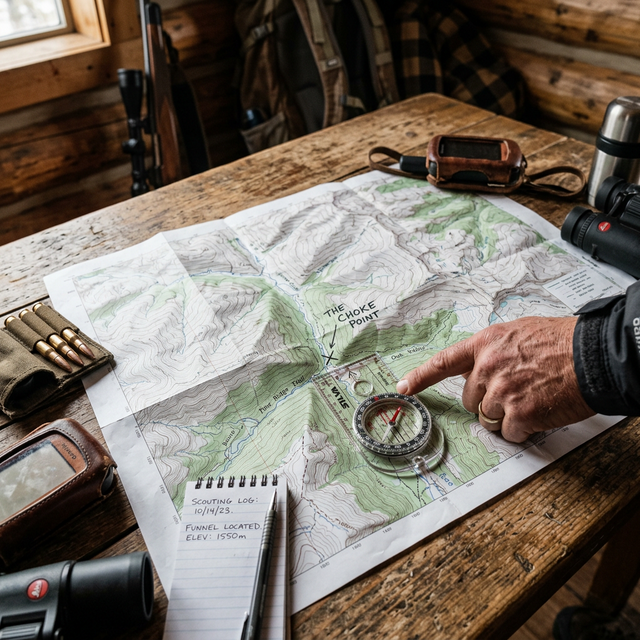
Identifying and Hunting Whitetail Pinch Points: Mastering the Natural Funnel
Find and hunt whitetail pinch points with topo maps: saddles, creek crossings, inside corners, fences, and stand setups that remove guesswork.
A mature buck is paranoid and adaptable—but he still cannot fly. Steep slopes, rivers, cliffs, and impenetrable cover dictate where he walks. Identify those restrictions and you replace guessing with geometry.
Pinch points (funnels) concentrate travel into narrow, huntables lanes. Master them and average acreage suddenly produces above-average encounters.
What Is a Pinch Point?
A pinch point is any natural or man-made feature that forces deer into a tight path.
Picture 500 acres of open oak timber where deer wander freely. Now cut a sheer ravine through it, leaving a 20-yard strip between cliff and river. Every deer crossing that block uses the strip. That gap is a pinch.
You are not predicting a random tree. You are sitting where physics says they must pass.
Finding Funnels on Maps and Imagery
Start on screen before you burn boots. Use topo + satellite + ownership layers from e-scouting practice.
Mark these classics:
- Inside corners: Timber meets field at a sharp 90°. Deer cut the corner 10 to 30 yards inside cover.
- Creek crossings: Steep banks are barriers; wide contour spacing shows gentle fords. Trails braid into one ford.
- Fence gaps / jumps: Miles of wire with one downed or low section become a highway. See also fence jumps and ditches.
- Timber fingers: Narrow cover between two fields or clear-cuts.
- Saddles: Low dips in ridgelines—hourglass contour shapes on topo.
Confirm with cameras before you invest heavy stands. Trail camera placement on funnels during fall proves daylight worth.
Why Mountain Saddles Are Lethal
On hills, saddles are often the highest-percentage funnels.
- Deer crossing from one drainage to another take the lowest effort pass over the ridge.
- Rutting bucks cruise saddles while seeking does across big country.
- Hang on the downwind side of the saddle notch, not the scenic peak.
If wind blows through the saddle into your face from expected travel, you are often in the right zip code—verify thermals at dawn/dusk because ridges swirl.
Man-Made and Hybrid Funnels
Humans accidentally build pinches:
- Logging road bottlenecks between thick regeneration
- CRP strips pinched by ditches
- Food-plot bottlenecks between blocks of cover
- Water gaps and cattle gates on farms
Hinge-cutting can create funnels on private land by blocking travel and leaving one intentional lane—coordinate with TSI / hinge-cutting so you do not seal off your own access.
Stand Placement and Wind
Finding the funnel is step one. Hunting it clean is step two.
- Sit slightly off-center downwind of the primary trail, not directly over muddy tracks.
- Archery: 15 to 25 yards from the lane with shooting lanes cut discreetly.
- Firearms: you can sit farther, but do not silhouette on the notch skyline.
- Have a SW-wind tree and a NW-wind tree marked for the same pinch.
- Enter without walking the funnel trail itself.
Mobile hunters can adapt trees daily with saddle hunting.
When Pinch Points Produce Best
| Season window | Funnel behavior |
|---|---|
| Early season | Food-to-bed edges and field corners |
| Pre-rut seeking | Saddles, creek crossings, fence gaps light up |
| Peak / lockdown | Some open funnels die; thick micro-pinches near bedding win |
| Late season | Funnels tied to remaining food and thermal cover |
During seeking week, combine pinches with pre-rut tactics. During quiet lockdown, shift toward cover-oriented pinches near bedding.
Mistakes That Waste a Perfect Funnel
- Hunting it on the wrong wind “because it’s the spot”
- Cutting three huge shooting lanes that scream human
- Parking where deer see/hear you before they enter the pinch
- Overhunting the only saddle on a 80-acre farm every weekend
- Ignoring secondary trails 40 yards parallel to the muddy highway
Pinch-Point Hunting Checklist
- Map 5+ candidate funnels with wind notes
- Camera confirm for 1–2 weeks when possible
- Mark entry that avoids the travel lane
- Prep one tree per primary wind
- Rest after a busted sit
- Recheck after crop harvest or flooding changes routes
River country hunters should also study creek crossings and bottoms—water barriers create some of the cleanest pinches in flat states.
Ground-Truthing a Digital Funnel
Map funnels lie sometimes. Verify:
- Are there multiple fresh trails, or one old cattle path?
- Do rubs face the direction you expected for morning versus evening?
- Is the “pinch” actually bypassed by a parallel trail 50 yards away in better cover?
- Can you access without scent-checking the lane?
Spend a midday hour with a camera and a wind checker before you cut lanes. If mature tracks skip the scenic saddle for a brushy ditch parallel to it, hunt the ditch.
Building Soft Funnels on Private Land
Where terrain is flat, manufacture gentle squeezes:
- Hinge a half-acre block leaving one 15-yard travel seam.
- Plant a screening strip that forces deer around a corner into your lane.
- Gate a fence opening and retire other gaps.
- Place a mock scrape or water tank just inside the squeeze to pause bucks.
Keep manufactured funnels subtle. A wall of brush with one neon shooting lane looks like a trap to pressured deer. Blend edges and cut only the windows you need.
Field Notes and Practical Numbers Use these benchmarks to keep decisions concrete rather than vague:
- Log every sit with date, wind direction, temperature, and deer observations—patterns appear after 8 to 12 recorded hunts on the same property.
- Limit first-time pressure on a hot pin to one quality sit, then rest at least 24 to 48 hours unless the rut calendar demands otherwise.
- Carry a short checklist in your phone notes so gear and safety steps do not depend on memory at 4:30 a.m.
- Revisit your plan weekly during the season; crops, pressure, and breeding phases change the right answer.
- When in doubt, choose the option that leaves mature deer less educated for the next sit—longevity beats one burned encounter.
These habits compound across a season and across years on the same ground.
Successful hunters treat preparation as part of the hunt itself. Write down what worked, what failed, and what you will change next time. Small improvements in access, timing, and patience usually matter more than buying another gadget. Stay flexible after weather swings, keep safety non-negotiable, and measure success by clean opportunities and ethical recoveries—not only by antlers on the wall. Over a full season, disciplined routines outperform random hard hunting.
Multiple Funnels, One Property Plan Rank pinches A/B/C by:
- Trail freshness and mature track size
- Wind options for clean access
- Distance from parking pressure
- Camera daylight proof
Hunt A on perfect wind, B on secondary wind, and save C for overflow or scouting. Recycle rankings after harvest, flooding, or a neighbor clear-cut. A property with three honest pinches and rotation almost always beats one famous saddle hunted to death every Saturday.
Keep refining your approach with honest notes after every outing. Track winds that worked, access mistakes, and timing windows that produced daylight movement. Share lessons with your hunting partners so the whole group improves pressure management. Small, consistent upgrades in planning usually add more encounters than a single new piece of equipment. Stay patient through slow sits, stay aggressive when sign and weather align, and protect the long-term health of the places you hunt.
Frequently Asked Questions
How narrow does a funnel need to be?
Tighter is better, but even a 40- to 80-yard soft squeeze beats a half-mile open bench. Ultra-tight 10- to 20-yard gaps are archery gold.
Are funnels only for the rut?
No. Early and late seasons use food-driven funnels daily. Rut multiplies traffic through terrain funnels.
Should I hunt the same pinch all season?
Rotate. A saddle can handle more sits during seeking week and fewer in early October. Watch camera daylight trends.
What if two trails share a pinch?
Hang where you can cover the merge with minimal movement, or pick the trail with mature-buck track size and rubs.
Do food plots replace natural pinches?
Plots create destinations; pinches create paths. Best properties use both—plots outside cover, funnels on the walk in.
Pinch points remove luck from travel routes. Read the barriers, sit the gap on the right wind, and let the landscape push deer into range.
Wildsnap • Open beta
Join Wildsnap and try the beta
In the open beta, you turn trail-cam data into actionable insights—free, fast, and simple.
No credit card