
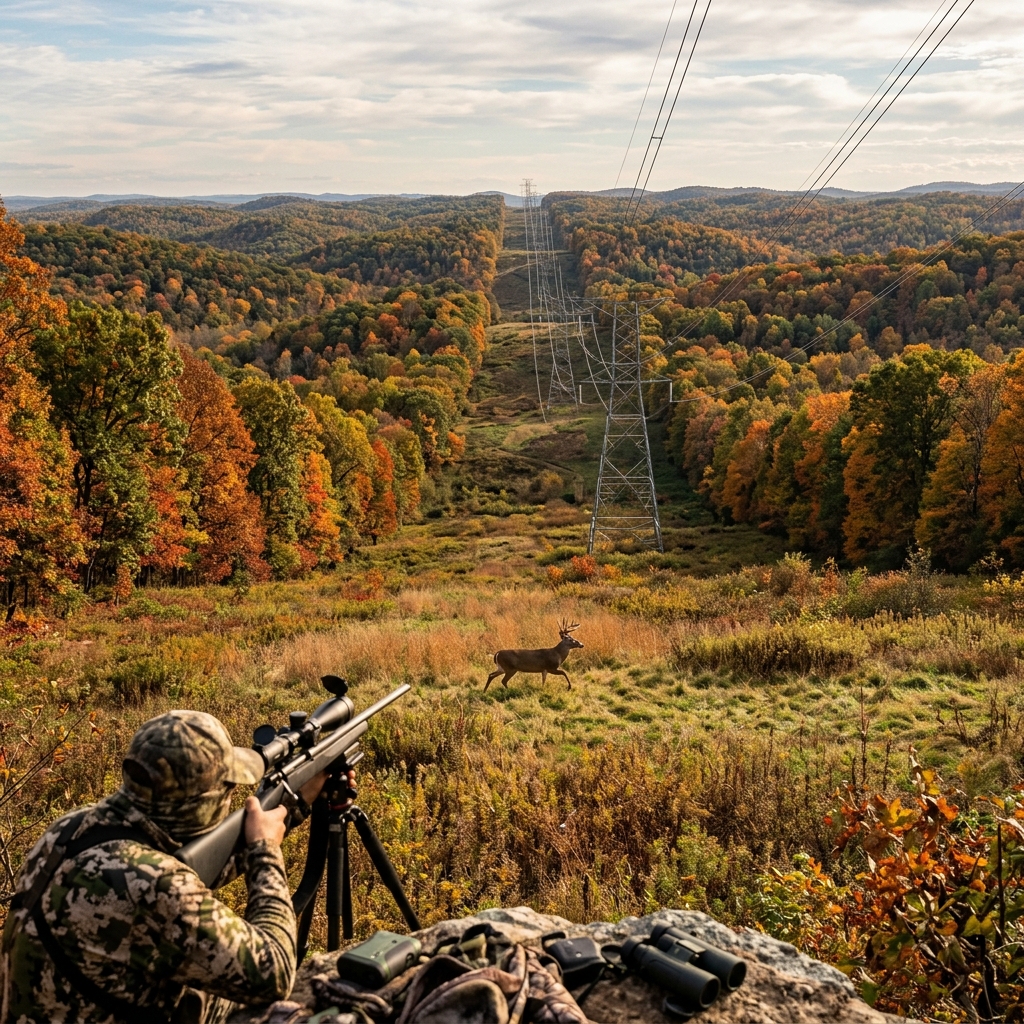
Hunting Powerline Clearances: Mastering the Utility Right-of-Way
Powerline rights-of-way create miles of edge browse and long sightlines. Learn feathered-edge travel, low-spot crossings, stand setbacks, and safety rules.
Utility right-of-ways (ROWs)—especially powerline clearances—cut corridors through timber that would otherwise stay dark and uniform. Those maintained lanes create early-successional browse, hard edges, and rare long sightlines. Hunted correctly, they are highways. Hunted lazily from mid-span under a tower, they educate every buck in the section.
Powerlines cross properties that would otherwise be impossible to hunt visually—deep timber with no field edges. The corridor gives you a readable edge and crossing points you can map from afar. The hunters who win on ROWs treat them like transition zones with extra-long sightlines, not like open fields.
Why Powerlines Concentrate Deer
Utilities keep lanes clear of tall canopy with mowing, cutting, or herbicide cycles. Disturbed soil plus full sun sparks high-stem-count browse: briars, saplings, forbs, and grasses.
To deer, a 50–150-foot-wide ROW can be:
- A linear salad bar stretching for miles
- A daylight travel edge with escape cover on both timber walls
- A crossing zone between large timber blocks
Edge biology here mirrors other seams—see habitat transition zones and ag edges vs big timber.
Maintenance cycles matter. A ROW cut two years ago may hold 6-foot briars and saplings—prime deer cover. A freshly sprayed corridor can look like a lawn and produce little browse for a season. Ask locally when the utility last mowed or treated, or read stem density from aerials.
The Feathered Edge vs the Open Center
Amateur mistake: pop a blind in the grassy middle and hope. Mature bucks rarely stroll center-span in daylight.
They prefer the feathered edge—roughly the first 10–20 feet where briars meet timber. Trails often parallel the wires inside that brush seam for long distances.
Hunt the parallel trail, not the postcard view down the cut.
When bucks must cross the ROW, they choose concealment:
- Topographic dips
- Brushy creek crossings
- Eroded ditches
- Low spots that hide them from skylining
Walk the cut in the off-season and mark every low crossing. Those points beat random mid-hill spans.
Deer crossing a ROW behave like deer crossing any open gap: they sprint the vulnerable section or use cover to break up the exposure. A crossing where timber juts into the cut on both sides—creating a 20-yard choke—is worth more than a 100-yard bald span.
Similar pinch logic appears in natural funnels: fence jumps and ditches.
Stand Placement: Ghost Setbacks
Set stands 25–40 yards into timber off the crossing or parallel trail—not on the first tree in the open.
Benefits:
- Timber shadow breaks your outline
- You avoid scent tunneling straight down the grassy corridor
- Deer commit to the edge before they can skyline you
Cut narrow lanes to the feathered edge and the crossing throat. Keep a second tree ready for opposite winds.
Observation first: Powerlines are one of the few Eastern spots where you can glass 300–500+ yards. Early November observation from a distant, legal vantage can reveal exact pop-out points before you hang steel.
Hang sets for both parallel travel and crossing traffic. A buck cruising the timber wall during the rut may never step into the open center but will pop out at a low dip. A feeding doe group may parallel the edge for a quarter mile. Two stand types, two wind charts.
Seasonal Patterns on Rights-of-Way
| Season | Deer use | Hunter focus |
|---|---|---|
| Early season | Browse feeding along edges | Evening feathered-edge sits |
| Pre-rut / rut | Bucks cruise timber walls scent-checking | Crossings + parallel trails all day |
| Late season | Thermal edges, leftover browse | South-facing edges, leeward cuts after storms |
After ROW maintenance (fresh cut or spray), browse can explode for 1–3 years. Fresh cuts can also displace deer briefly—give them time to resettle before hunting hard.
Rut cruising along ROW timber walls can produce all-day action if pressure stays low. Bucks use the linear edge to scent-check does without crossing open span. Sit parallel trails on rut-wind days rather than only evening food logic.
Compare early-successional hunting ideas with clear-cuts and logging roads.
Access, Maps, and Permission
Not every powerline is free to hunt.
- Confirm property ownership under the wires—utility easement ≠ hunting permission
- Obey posted gates, vehicle bans, and locked access roads
- Park legally; do not block maintenance gates
- On public land, verify weapons restrictions and safety zones near infrastructure
E-scout the corridor on aerials, then ground-truth crossings. Note tower numbers as landmarks for wind-specific stand lists.
Utility companies maintain access roads along many ROWs. Using those roads to reach a stand can be legal on private land with landowner permission but illegal on some public parcels. Never assume. A locked gate exists for a reason—park outside and walk in.
Optics and Long-Lane Tactics
Powerlines reward disciplined glassing.
- Pick a shaded, recessed spot with a wide view of two or three candidate crossings
- Grid the feathered edges slowly—bucks show as horizontal lines in briars, not center-span silhouettes
- Mark time, wind, and exact exit point
- Move a stand to that micro-crossing on a matching wind within 24–48 hours if pressure allows
Rifle hunters may have longer shots across open span; bowhunters should still think 20–40 yards at the timber edge. Do not take unsafe skyline shots toward towers, roads, or unknown backgrounds.
Binoculars beat riflescopes for observation. Scan the timber wall at briar height, not eye level. A rutting buck’s antler tips may be the only visible sign as he parallels cover 15 yards inside timber.
Trail cameras on ROW crossings should be locked and concealed. Theft rates run high on visible corridors. Cellular cameras reduce return trips.
For camera strategy off the beaten path, see securing trail cameras on public land.
Wind, Thermals, and Open Corridors
Open ROWs behave like long valleys for wind. A northwest wind may blow straight down the cut for a mile while timber on either side stays calmer. Scent carries farther in open grass than under canopy.
Morning thermals often pull air up slope and into the cut from both timber walls. Evening thermals reverse. Plan entry so you never walk the open span upwind of a stand.
Crosswind setups are dangerous on ROWs. Your scent may lane down the entire corridor. Prefer winds that blow from the stand into timber on the non-travel side, or into the open span away from known crossing points.
Pair ROW wind logic with understanding thermals on hilly terrain where cuts cross slopes.
Utility Infrastructure Safety
Hunting near high-voltage infrastructure demands non-negotiable rules:
- Never climb transmission towers or attach stands to utility structures. Arc flash and electrocution risk is real in humidity and rain.
- Stay off guy-wires, substations, and posted equipment pads
- Treat transformer hum as acoustic masking: it hides your noise and approaching deer—rely more on vision
- In storms, leave the corridor; open lanes are poor places for lightning decisions
- Keep carbon arrows, metal poles, and wet gear away from low lines on distribution cuts (know what you are hunting under)
Respect distance. A deer is not worth contact with energized gear.
Transmission lines (large steel lattice towers) carry far higher voltage than distribution lines on wood poles along field edges. Know which you are hunting under. When in doubt, stay farther from conductors and never raise a bow or rifle toward wires.
Frequently Asked Questions
Do bucks walk the center of powerlines? Occasionally at night or in fog. Daylight mature bucks usually parallel the feathered timber edge or cross in low spots.
How far into the woods should I hang? Often 25–40 yards, adjusted for shot lanes and wind. Far enough to hide, close enough to cover the edge trail.
Is a powerline better for rut or early season? Both. Early season favors feeding edges; rut favors crossing/cruise traffic. Match sit duration to the phase.
Can I use a ground blind on the ROW? Yes if brushed into the edge well off center and legal. Avoid lonely boxes in open grass.
What wind is best? Any wind that blows scent into the non-travel timber or open unsafe areas—not down the lane into the crossing. Have mirrored stands for opposite winds.
Are all utility clearances equal? No. Fresh early-successional growth with thick edges beats sterile gravel pads and constantly mowed lawn-like spans.
Master the feathered edge and the low crossing—not the middle of the cut. Used with wind discipline and infrastructure respect, powerline corridors become long-distance deer highways you can finally read.
Wildsnap • Open beta
Join Wildsnap and try the beta
In the open beta, you turn trail-cam data into actionable insights—free, fast, and simple.
No credit card