
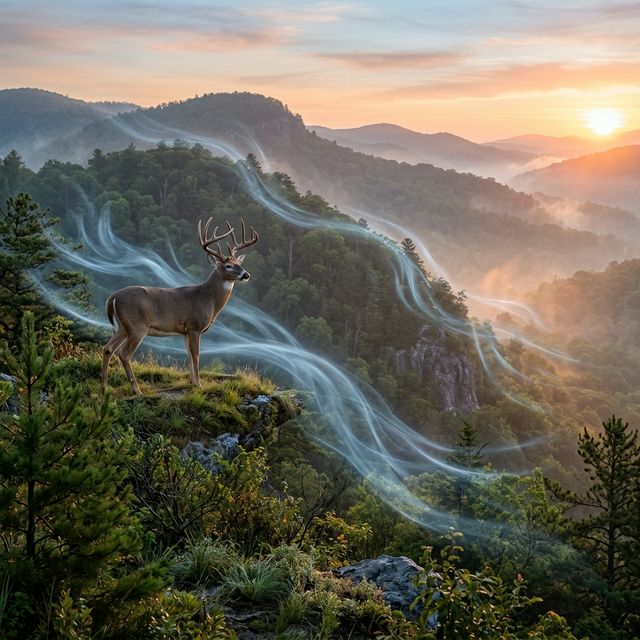
Understanding Thermals: How Air Currents Dictate Deer Movement
Master morning and evening thermals for whitetail hunting. Learn how rising and falling air move scent—and how mature bucks bed to use both.
In hill country, the compass wind is only half the scent story. Thermals—vertical air movement driven by temperature—carry your odor up ridges at midmorning and dump it into creek bottoms at dusk like water. Mature bucks don’t merely “check the wind.” They bed and travel where wind and thermals overlap into a safety pocket.
If you hunt flats exclusively, thermals matter less. If you hunt hollows, benches, and bluffs, they decide whether you get busted at 8:10 a.m.
What Are Thermals in Deer Hunting?
Thermals are rising or falling air caused by heating and cooling surfaces.
- Rising thermals (morning pull): Sun warms valleys and slopes; air lightens and climbs. Milkweed can lift 50–100+ feet straight up on a clean morning.
- Falling thermals (evening dump): After sundown cooling, denser air drains downhill, pooling in bottoms and hollows.
They are strongest on clear days with larger day/night temperature swings—think a 40°F night into a 65°F afternoon. Cloudy, windy days mute thermal effect; steady 15 mph winds can overpower gentle thermal drift.
How Do Morning Thermals Affect Your Scent?
On a morning sit:
- Pre-dawn air is often still draining downhill or neutral.
- Shortly after sunlight hits, valley air warms and begins to rise.
- Your scent lifts—helpful if you’re on a ridge hunting deer below, disastrous if you’re halfway down a slope with bucks bedded above you.
Tactical take: Morning ridge sits can loft scent into open sky if you stay high and the thermal is clean. Morning sits tucked under a bedding ridge often send odor straight into the bed when the pull begins.
Confirm with milkweed or fine powder every 15–20 minutes through the transition. For entry discipline when scent goes wrong, see What to Do If You Spook a Deer.
How Do Evening Thermals Dump Scent Into Bottoms?
Evenings reverse the engine:
- Cooling slopes send air—and your scent—downhill
- Creek bottoms become scent collection zones
- Bucks often approach food sources with their nose in that drainage
Tactical take: Evening stands above a destination field can work if your scent dumps behind the deer’s approach. Evening stands in the bottom of a hollow put your odor in the exact lane deer are sniffing.
Leave early enough that you’re not climbing through the dump zone while deer are already on their feet.
What Is a Thermal Eddy and Why Does It Bust Hunters?
Air doesn’t rise in a perfect elevator shaft. Terrain creates turbulence.
Common eddy makers:
- Cliff bands and rock outcrops
- Sharp bends in hollows
- Converging draws
- Dense conifer pockets that block flow
In an eddy, scent swirls and pools. Powder may show five directions in two minutes. If you’re hunting a known swirl saddle, shorten sits during transition or move 40–80 yards to cleaner air.
Baseline scent habits still apply—Whitetail Scent Control—but no detergent beats a thermal eddy at 20 yards.
How Do Mature Bucks Bed Using Wind and Thermals?
A classic mature-buck bed sits on the leeward side of a ridge, often about one-third of the way down from the crest:
- Rising morning thermals bring scent from below
- Prevailing wind over the crest covers the rear
- Eyes watch downhill open lanes
That’s why walking ridge spines at dawn is a famous way to bump giants. E-scout benches and leeward pockets before you hike—E-Scouting Whitetails—and confirm with carefully placed cameras (Trail Camera Placement During the Rut).
When Is the Thermal Transition Most Dangerous?
The ugly window is roughly 20–40 minutes when air switches from falling to rising (morning) or rising to falling (evening). Dead air settles. Gusts swirl. Hunters get nose-busted without a “bad” forecast wind.
How to handle it:
- Be in the stand before the switch when possible
- Avoid moving during the peak swirl
- Hunt edges of terrain features with cleaner laminar flow
- On marginal days, choose flatter access routes
Weather apps won’t label “thermal chaos.” Your milkweed will.
How Do You Practice Reading Thermals Before Season?
- Walk your property in September with milkweed at dawn and dusk.
- Map where scent goes at 30-minute intervals on a cold clear day and a warm cloudy day.
- Mark swirl zones as “transition only / avoid.”
- Build stand sites for specific wind plus thermal assumptions—not wind alone.
- Re-check after leaf drop; canopy loss changes heating and flow.
Pair thermal maps with pressure and temp movement notes—Wildsnap users often correlate camera activity with weather shifts, which reinforces when deer move relative to fronts, while thermals still govern whether your scent arrives first.
For late-season cold that strengthens dumps and bedding choices, see Late Season Whitetail Tactics and Post-Rut Late Season Food Sources.
How Do Rain, Fog, and Cloud Cover Change Thermals?
Not every day builds a textbook rise-and-dump cycle.
- Heavy overcast: Weaker heating → weaker rising thermals
- Steady rain: Often damps vertical movement; surface winds dominate
- Fog in valleys: Can trap scent low longer into the morning
- Post-frontal bluebird sun: Strong, early thermal lift—be set early
- Hot October afternoons: Rising air can persist; evening dump may start later than you think
Build two stand choices for the same funnel: one that assumes a clean dump, one that assumes swirl. Decide at the truck based on sky conditions, not yesterday’s memory.
Can You Use Terrain to Create a Scent Advantage on Purpose?
Yes—hunt like the buck beds.
Examples:
- Sit a point where rising scent lifts over a creek bedding thicket while you watch the sidehill trail
- Evening setup on a bench where falling air slides behind your position into a ditch deer aren’t using
- Avoid saddles that act as wind tunnels during transitions unless you like 360° swirl
Milkweed mapping in the off-season is the cheapest “scent control product” you’ll ever buy. Spend two mornings documenting flow and you’ll save a season of mysterious blowups.
How Do You Combine Prevailing Wind Forecasts With Thermal Reality?
Use forecasts for the big arrow (NW at 8 mph). Use milkweed for the little arrows (down the ditch at dusk).
A practical morning checklist:
- Read forecast wind and gusts.
- Ask whether clear sun will create early lift.
- Choose a stand that works if lift starts at 8:15 a.m.—because it might.
- Pack an alternate tree if the hollow is already swirling when you arrive.
Evening checklist:
- Expect dump into the lowest terrain around sundown on clear days.
- Do not sit where your scent will drain into the exact trail deer will use.
- Exit routes matter—walking out through the dump pool can blow tomorrow’s sit tonight.
Hunters who only check apps get surprised. Hunters who check apps and fluff become boringly consistent.
What Does “Dead Air” Feel Like and How Do You Hunt It?
Dead air is the unsettling calm when powder hangs, rises an inch, then falls. Deer often move then—and so does your scent, in every direction.
Tactics: sit higher if possible, reduce movement, and accept shorter effective range. Some hunters climb down and relocate rather than soak in a swirl bowl. Stubbornly staying through 40 minutes of dead air on a sidehill bed edge is a common way to get blown without understanding why. Re-check powder after every major posture change in the stand; your body heat plume can create a private swirl even when the hollow looks stable.
Frequently Asked Questions
Do thermals matter on flat farmland?
Less than in hills, but ditch lines, riverbanks, and even slight rolls create mini-drainages. Don’t ignore powder just because the county is “flat.”
Can I trust a wind app for thermals?
Apps show regional wind, not local vertical drift. Use them for prevailing direction, then verify on-site.
Should I hunt high in the morning and low in the evening?
Often yes in hill country: mornings high to ride the lift, evenings positioned so the dump doesn’t blow into approaching deer. Terrain specifics always override slogans.
What’s the best thermal indicator?
Milkweed, cattail fluff, or ultra-fine powdered indicator. Cigarette smoke works but announces your presence—avoid it.
Why was my wind “perfect” and I still got blown?
You likely hunted through a transition eddy or had falling thermals carrying scent into a bed below/above you. Perfect compass wind ≠ perfect scent path.
Treat thermals like invisible creeks. Map where they run, hunt the transitions carefully, and bed-side bucks will make a lot more sense—and a lot less noise leaving.
Know which conditions actually trigger daytime activity
Connect your cameras and see which conditions really trigger movement — not guesswork.
No credit card
Wildsnap • Open beta
Know which conditions actually trigger daytime activity
Connect your cameras and see which conditions really trigger movement — not guesswork.
No credit card