
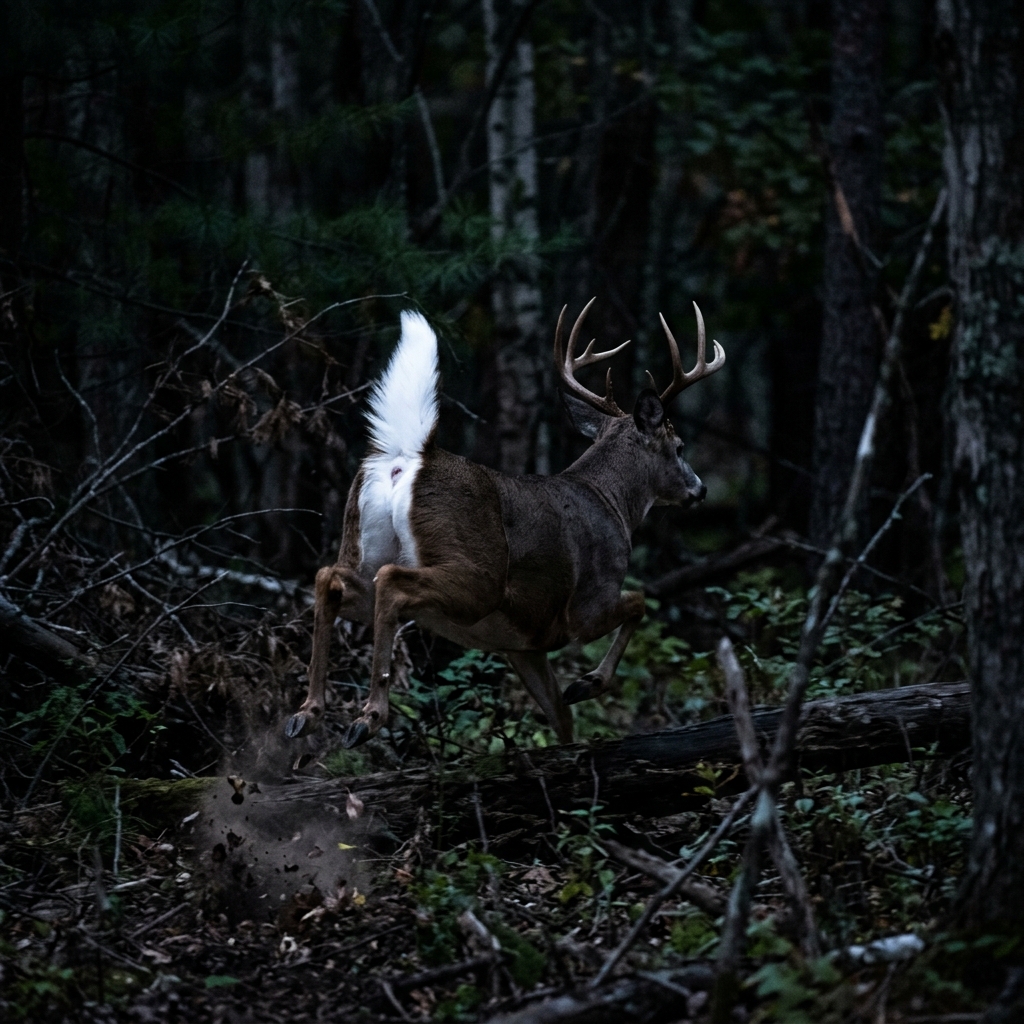
What to Do If You Spook a Buck
Spooked a buck? Learn how to judge minor vs. major spooks, realistic recovery timelines, when to stay put, and how to reset pressured stands.
It happens to every hunter. You’re five minutes from the stand when a stick cracks underfoot, a loud SNORT cuts the timber, and white flags crash away. The gut punch is real—but the hunt isn’t automatically over. Outcomes depend on how the deer busted you: nose, eyes, or ears—and whether it catalogued you as definite human danger.
Learn to classify the spook, adjust the sit, and protect the pattern for next time.
How Do You Tell a Minor Spook From a Major Spook?
Use this field triage:
| Spook type | What the deer got | Typical reaction | Recovery window |
|---|---|---|---|
| Sound only | Twig, pack scrape | Short run, look-back | Minutes to hours |
| Sight, unclear | Partial silhouette | Blow, circle, stare | Same sit possible |
| Sight, clear | Saw you draw/move | Hard exit | 24–72 hours |
| Scent confirmation | Lungful of human | Long exit, may abandon route | 3–7+ days |
| Scent + sight | Full ID | Pattern shift likely | Rest the spot |
Mature bucks forgive less than does and yearlings. A doe blow doesn’t always equal a ruined ridge—but a 5.5-year-old that smelled your entry may night-walk that trail for a week.
Will a Buck Come Back If He Smells You?
Scent is the serious spook. A deer’s nose is its primary defense.
What happens:
- Immediate departure, often with a blow
- Temporary abandonment of that trail or food edge
- Increased night-only movement through the area
What to do:
- Stop hunting that stand immediately if the encounter was on your entry route to a bedding-adjacent setup.
- Rest the spot until wind direction changes and rain or heavy dew helps scrub scent—often 3–7 days.
- Re-enter from a new angle that keeps your wind off bedding.
- Shorten future entries; leave more time buffer (arrive 45–60 minutes earlier without rushing).
Double down on habits from Whitetail Scent Control and play thermals—see Understanding Thermals.
What Does It Mean When a Deer Snorts or Blows?
Blowing is an alarm broadcast.
Nuance matters:
- Single snort + short run: Often uncertainty. Stay frozen. Curious deer—or the same deer—may ease back within 10–30 minutes.
- Repeated blows while stomping: They know something is wrong. The sit may be burned for daylight movers on that trail.
- Blow from 80+ yards with no clear look: Sometimes they smelled a swirl, not you specifically. Still freeze; assess wind.
Do not grunt back at a blowing deer hoping to calm it. That usually confirms danger.
What Should You Do in the First 60 Seconds After a Bust?
- Freeze. Movement after the alert finishes the education.
- Mark the wind with milkweed or powder—did a swirl betray you?
- Listen for how far they go and whether they stop.
- Decide: stay (sound/sight uncertain) vs. abort (hard scent bust near bedding).
- If staying, wait a full 20–30 minutes before any gear adjustment.
If you were almost to the tree, climb only if you’re sure the deer didn’t watch you do it. Being busted mid-climb is a major sight spook.
How Long Before You Hunt That Stand Again?
Rules of thumb—not laws of physics:
- Twig snap, deer never ID’d you: finish the sit
- Visual at 30 yards, no scent: wait 24 hours, change entry
- Scent bust on evening food source: skip 1–2 rotations, return on a different wind
- Scent bust near bedding: rest 4–7 days, hunt the fringe instead
- Rut exception: testosterone makes some bucks reckless—return sooner only if cameras show daylight travel resumed
Cameras help you know whether “rest” worked without walking in daily—see Managing Trail Camera Data and Trail Camera Placement During the Rut.
Can You Turn a Spook Into a Learning Opportunity?
Yes—if you’re honest.
Ask:
- Did I walk the skyline at dawn?
- Did I trust a northwest wind while thermals dumped down the hollow?
- Did I brush scent against goldenrod along the trail?
- Did I leave the truck door slam echo across the field?
Log the bust in your hunt notes with time, wind, and location. Patterns in your mistakes are more valuable than blaming “pressured deer.”
During the rut, a spooked doe group can still pull a trailing buck through minutes later. Stay ready—and review Expert Blood Trailing Tips so if you do get a rushed shot in chaos, you’re prepared to finish ethically.
How Do You Prevent the Next Blowup?
Prevention beats recovery:
- Wind first, stand second—no exceptions
- Entry routes that stay off travel trails when possible
- Noise discipline—quiet fabric, taped metal, soft soles near the tree
- Light discipline—red/green lamps pointed down
- Thermal timing—avoid the chaotic 20–40 minutes when morning air lifts or evening air falls if your stand is in a swirl zone
- Mobile options—if you bump deer walking in, have a Plan B tree 75–100 yards away (Using a Climbing Tree Stand Safely or Mastering Saddle Hunting)
Public land pressure multiplies spook consequences. Private land still isn’t forgiving if you educate the same mature buck twice in a week.
Should You Relocate After Spooking Deer on the Walk In?
Sometimes the best move is a 90-yard audible.
If you bump deer between the truck and the tree and they didn’t fully nose-ID you:
- Stop. Don’t march into the original stand like nothing happened.
- Check wind for an alternate tree on the same funnel or the next finger of cover.
- Favor a setup that watches the escape direction they used—curious deer often circle downwind.
- Keep the move quiet; don’t rattle gear while frustrated.
Mobile gear earns its keep here—climbers and saddles turn a busted Plan A into a same-morning Plan B. Fixed hang-on hunters should pre-set a backup stand on a different wind for exactly these mornings.
If the bump happened inside primary bedding, leave. Hunting a freshly emptied bedroom teaches you nothing except how fast deer can quit daylight.
How Do Multiple Spooks in One Week Change Your Season Plan?
Two scent busts on the same ridge in seven days means that ridge is now a night pattern until a hard reset (big rain + rest + new entry). Shift to:
- Adjacent funnels 150–300 yards away
- Destination food edges with better wind options
- Midday sits that avoid dawn thermal chaos
Stubbornness is not woodsmanship. The mature buck you’re chasing already logged you as a predator GPS ping—give him a reason to forget.
How Do You Handle Spooking Deer During the Shot Sequence?
A special case: you draw, the buck bolts, or you punch the release and tick a branch. That is both a spook and possibly a hit.
- Mark the exact spot mentally—range, tree, angle.
- Listen for a crash vs. steady running.
- Wait the standard blood-trailing time unless you saw a definitive lethal hit.
- Do not assume “he was only spooked” if the arrow disappeared into him.
Review Expert Blood Trailing Tips before you grid the timber. The worst outcome is convincing yourself it was a clean miss when it was a marginal hit. Mark coordinates, involve a partner, and read sign honestly.
Frequently Asked Questions
If a deer flags but doesn’t blow, is that better?
Usually yes. Silent exits often mean low certainty. Stay put and stay still.
Should I leave immediately after a major scent bust?
If you’re near bedding and the buck hard-exited downwind of you, leaving carefully can be smarter than grinding a dead sit—especially if your exit also contaminates the area. On food-source edges with an hour of light left, staying can still pay if other deer weren’t involved.
Do does forgive more than bucks?
Often. Does return to food faster. Mature bucks may shift to night use. Don’t let doe activity trick you into thinking the target buck is fine.
Can rattling bring a spooked buck back?
Rarely right away. Calling after a scent bust usually looks suspicious. Save calling for deer that haven’t ID’d you.
What’s the biggest myth about spooking deer?
“Any spook ruins the season.” Untrue. Timing, severity, and pressure context decide. Learn, adjust, hunt smarter.
Classify the spook, protect the bedding, and fix the entry that caused it. Mistakes are tuition—just don’t pay the same fee twice on the same buck.
Wildsnap • Open beta
Join Wildsnap and try the beta
In the open beta, you turn trail-cam data into actionable insights—free, fast, and simple.
No credit card