
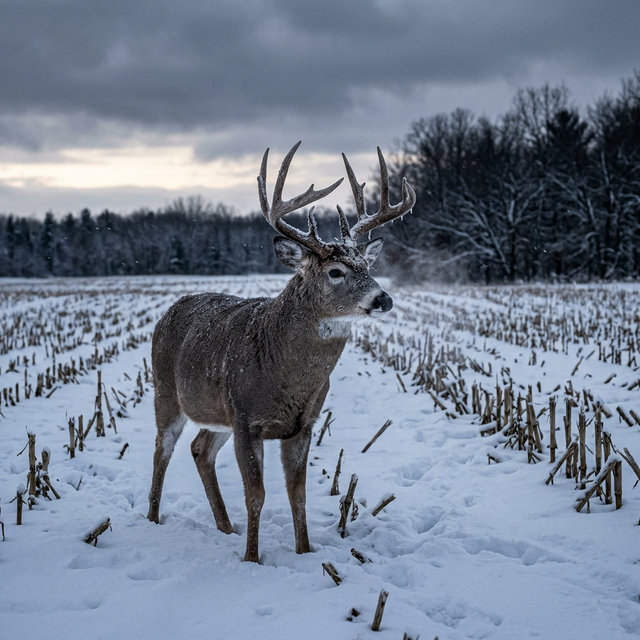
Late Season Whitetail Tactics: Finding High-Energy Food Sources
Tag late-season bucks by hunting high-energy food—corn, beans, brassicas—and midday thermal cover when December cold makes survival the only pattern.
The late season is uniquely honest. After the rut, romance dies and calories rule. December and January offer some of the year’s most predictable movement because mature bucks—down as much as 20–25% of body weight—are slaves to their internal furnace. Stop hunting “rut leftover” scrapes and start hunting high-energy food tied to thermal bedding with short, efficient walks.
Why Does Late Season Movement Get So Predictable?
Biology simplifies the map:
- Breeding drive fades for most bucks
- Cold raises caloric demand sharply below 20°F, and demand spikes harder under 0°F
- Deer minimize distance between bed and feed
- Daylight feeding increases on brutal cold fronts when nights are too costly
You’re not guessing random cruising anymore. You’re intercepting survival traffic. Deepen food strategy with Post-Rut Late Season Food Sources.
What High-Energy Foods Should You Prioritize?
After the rut, starch and carbs beat pretty clover that froze weeks ago.
Top late-season magnets:
- Standing corn — still the king where it exists
- Cut corn / waste grain — scoured by deer after harvest
- Standing soybeans (when available) — high protein/energy
- Brassicas (rape, turnips, radishes) — tops first, then tubers after freeze-thaw
- Winter wheat / rye — green bite during mild spells
- Soft mast leftovers / ag edges — secondary but useful
Watch for snow scuffing—craters where deer paw through crust to reach grain or bulbs. Fresh digs beat old tracks.
When Is the 1 PM to 4 PM Window Most Lethal?
On sub-zero mornings, deer often remain in thermal cover—cedars, pines, south-facing conifers—until the warmest part of the day.
Practical sit plan:
- Skip the suicidal dawn hike into bedding if your wind is marginal
- Arrive for a 11:30 a.m.–dark sit on the bed-to-feed edge
- Expect movement to build from 1–4 p.m. as deer stage toward food
- All-day sits shine when a major Arctic front crashes temps 20–30°F overnight
Dress for stillness: high-loft insulation, wind shell, chemical warmers. Frostbite on toes ends hunts quietly—and dangerously.
How Do You Hunt Bed-to-Feed Micro-Funnels?
Late-season deer spare steps. Find the shortest covered walk from sanctuary to calories—often 75–200 yards.
Micro-funnel examples:
- Cedar finger pointing at a corn corner
- Ditch or fence line linking CRP to beans
- Hedge row between pine bedding and brassica plot
- Creek crossing that funnels the only dry feet into a field
Set up to stay downwind of both bed and feed. Thermals dump hard on cold evenings—review Understanding Thermals. If you bump the bed once, you may night-shift the pattern for a week (What to Do If You Spook a Deer).
How Should Trail Cameras Guide Late-Season Sits?
Cameras on food edges tell you when the furnace runs.
What to log:
- First daylight arrivals after a cold front
- Wind directions on feeding events
- Which corners of the field get used (NW vs. SE can differ by 100 yards)
Pull cards sparingly—food-source intrusion educates night feeders. Cellular cams with battery discipline help (Trail Camera Tech: Battery and Solar, Managing Trail Camera Data). Wildsnap-style AI sorting is useful when overnight feeding dumps hundreds of doe photos and you’re hunting one mature buck’s daylight timestamp.
What Gear and Safety Issues Matter in Extreme Cold?
Late season injures hunters who underestimate cold.
Checklist:
- Layer system you can hike in without soaking sweat, then add loft at the stand
- Extremity warmers; spare gloves
- Ice awareness on creeks—4 inches of solid clear ice is a common minimum for walking; honeycomb ice after thaw-freeze is a trap
- Trekking poles / ice spud for questionable crossings—or don’t cross
- Bright blood trailing conditions are excellent in snow—know how to use them (Expert Blood Trailing Tips and Tracking Deer in Snow)
- Tell someone your plan; daylight dies early
If you can’t feel your fingers enough to shoot safely, end the sit. Tags aren’t worth permanent injury.
How Do Weather Fronts Trigger the Best Late Sits?
Hunt the first evening of a severe cold drop when deer feed heavily before the deepest freeze, and the first stabilizing day after when they must recharge.
Also watch:
- Softening temps after prolonged Arctic cold (deer move to rebuild)
- Fresh snow that makes noon tracks readable for same-day adapts
- Wind that lets you sit the downwind field edge without swirling into beds
Pass on 45°F bluebird days after Christmas if patterns go fully nocturnal—unless you’re on a rare refuge food source with cameras proving daylight.
How Do You Adjust When Crops Get Cut Overnight?
Late-season patterns shatter when the last standing corn falls on a Tuesday.
Response plan:
- Same-day recon from the truck and ditch lines—don’t march bedding.
- Shift cameras to new waste-grain corners and field pinch points.
- Look for the next-best energy: neighboring brassicas, bean stubble, or a refuge plot.
- Expect deer to bed tighter to whatever food remains—funnels shorten further.
- Give bumped deer a rest day after the combine circus.
Hunters who pre-map three backup food sources before Thanksgiving stay dangerous after harvest. Hunters married to one cornfield go home early.
Clothing and Stand Style for Four-Hour Cold Sits
You can’t kill a buck you leave at 2 p.m. because you’re shivering.
- Merino or synthetic base; never cotton
- Heavyweight midlayer + down/synthetic puffy in a dry bag until you’re settled
- Windproof outer that doesn’t sound like a trash bag
- Insulated boots roomy enough for wool socks and warmers
- Seat cushion or blind chair that blocks conductive cold from the platform
Ground blinds shine for comfort; just manage entry scent and windows. Elevated stands shine for wind—rotate your body slowly so fabric doesn’t pop. If you prefer mobility in big timber, keep climbs short and safety non-negotiable (Tree Stand Safety: Harness and Lifelines).
How Do You Balance Pressure When Everyone Hunts the Same Corn?
Late season concentrates hunters as hard as it concentrates deer.
Tactics when the obvious field is crowded:
- Hunt the staging cover 75–120 yards off the field on weekdays
- Sit the overlooked ditch that feeds the back corner
- Use snow track surveys at midday to find the true entry trail, then hang for the next cold evening
- Consider water access or longer walks to the field corner farthest from the road (Kayak and Canoe Access Hunting)
If you bump the field once with a noisy exit, skip a rotation. The late-season pattern is fragile gold—protect it like a lease sanctuary even on public ground.
Should You Hunt Scrapes in December?
Most primary scrapes go cold, but community scrapes near remaining food sometimes see light traffic. Do not build your late season around scrapes. Build it around calories and thermal cover. If a scrape happens to sit on the short walk from cedar bedding to standing corn, great—hunt the walk, not the scrape mythology. Watch barometric spikes paired with sharp temperature drops—those combo days often produce the best midday daylight pushes onto remaining grain. Be in the stand before the thermometer bottoms out, not after. Glass field edges with binoculars from the truck first; if the corn corner already holds three trucks, slide to your secondary funnel without adding more pressure.
Frequently Asked Questions
Should I rattle or call in the late season?
Light contact calling can work on rare occasions, but food and stealth beat aggressive rut tactics. Save the roar for next October.
Are food plots better than ag fields late?
Best answer: whichever still has digestible energy. A stripped plot loses to a standing corn corner every time.
How close can I set up to bedding in December?
Closer than October—routes are short—but the penalty for a bump is huge. Often the field edge or midpoint funnel is smarter than the bedroom door.
Do lock-ons or ground blinds work better in cold?
Insulated ground blinds are warmer for long midday sits; elevated sets can have cleaner wind. Both work if scent is right—see Ground Blind Strategies.
What’s the number one late-season mistake?
Hunting old rut sign instead of current food, or walking through bedding at dawn “to get settled” and shifting the pattern to midnight.
Find the calories, shorten the walk, sit the cold midday window, and stay warm enough to shoot straight. Late season is caloric math—solve it and giants become patterns again.
Confirm seasonal patterns from your cameras
Find patterns and time your hunts right when your camera history tells you what happened — and when.
No credit card
Wildsnap • Open beta
Confirm seasonal patterns from your cameras
Find patterns and time your hunts right when your camera history tells you what happened — and when.
No credit card