
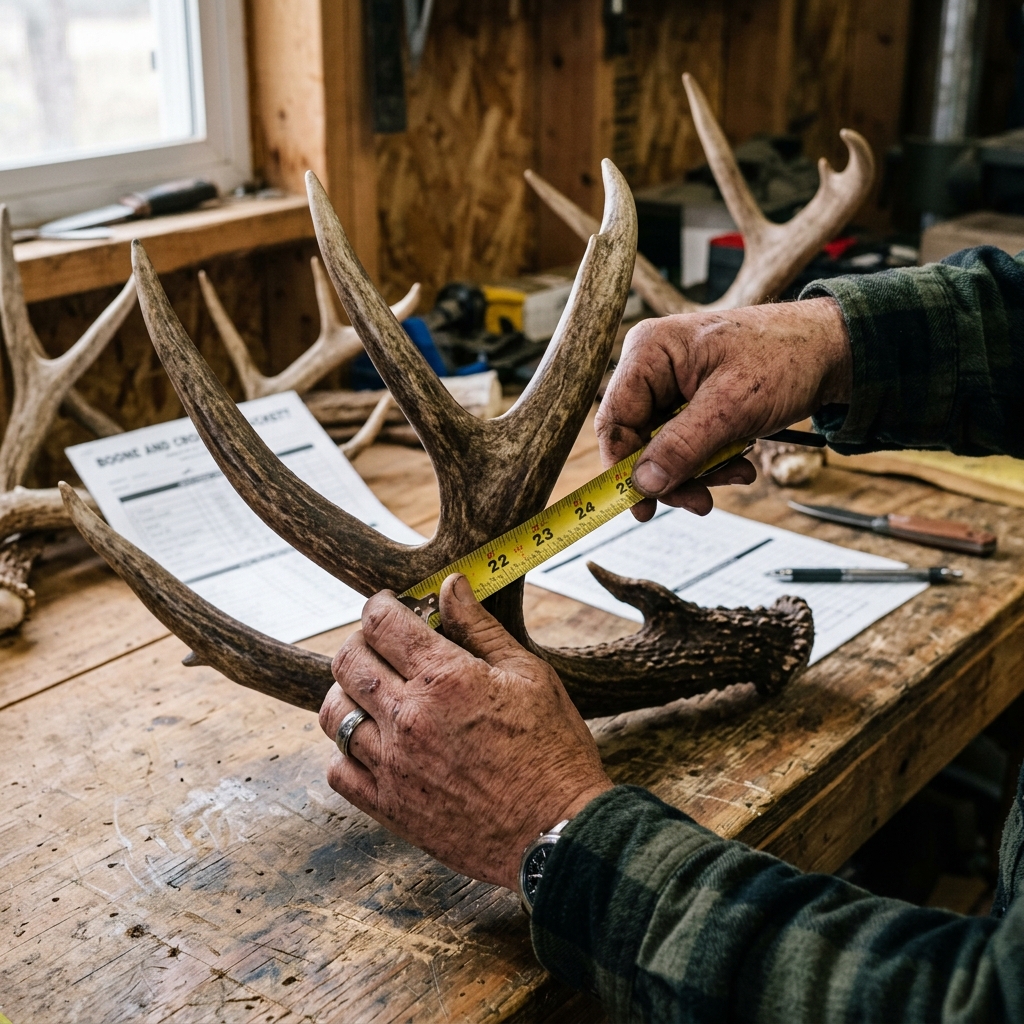
How to Score a Whitetail Buck: The Definitive B&C Guide
Score a whitetail with Boone and Crockett basics: gross vs net, beams, tines, mass, spread credit, green scoring tips, and common tape errors.
A whitetail score is a standardized way to describe antler size. Boone and Crockett (firearms-era records) and Pope and Young (archery) use nearly the same measuring framework, rewarding length, mass, and symmetry. Other systems exist, but B&C/P&Y literacy covers most camp debates.
This guide explains gross vs net, walks through the four core measurement groups, covers deductions and non-typicals, and lists mistakes that inflate or deflate backyard scores.
Gross Score vs Net Score
Gross score is total inches of antler measured in the system—beams, typical points, circumferences, and spread credit, plus abnormal points when you are totaling “all inches.” Many hunters prefer gross as a fair description of bone grown.
Net score subtracts asymmetry and, for typical entries, abnormal points. Record books use net. A buck with unmatched G2s loses the difference; a typical frame with a sticker point loses that sticker’s length in the typical net.
Neither number changes the hunt. They answer different questions: “How much bone?” vs “How symmetrical for the book?”
For antler character talk beyond inches, see understanding drop tines and non-typical deer.
Tools and Drying Rules
Use a flexible 1/4-inch measuring tape (steel or quality fiberglass). Official entries require a drying period—commonly 60 days at room temperature—before a certified measurer’s score. You can green-score immediately for personal knowledge; expect some shrinkage later.
Secure the skull or mount in a vise or clamps. Sharp tines cause eye injuries when racks slip—take that seriously.
Measurement 1: Main Beams
Start at the lowest outside edge of the burr where antler meets skull. Follow the outer curve to the beam tip. Measure both beams.
Beam length often separates good bucks from great ones before tines even enter the conversation.
Measurement 2: Typical Tines (G Measurements)
Typical points rise from the top of the beam. Label them sequentially:
- G1 — brow tine nearest the skull
- G2, G3, G4… — moving outward toward the beam tip
Measure from an imaginary baseline across the top of the beam at the tine’s emergence to the tip of the point. Do not follow the beam curve up the tine—go to the tip length above the beam.
A point generally needs to be at least one inch long and longer than wide at the base to count under standard rules—confirm fine print for official entries.
Measurement 3: Circumferences (H Measurements / Mass)
Take four mass measurements per beam (H1–H4), even on light 8-pointers.
- H1 — smallest circumference between burr and G1
- H2 — smallest between G1 and G2
- H3 — smallest between G2 and G3
- H4 — smallest between G3 and G4; if no G4, take H4 halfway between G3 and the beam tip
Mass is where quiet inches hide. Two bucks with identical tine length can differ by 10+ inches on circumference alone.
Measurement 4: Inside Spread Credit
Measure the greatest inside width between the main beams, perpendicular to the skull centerline as the system describes.
Cap rule: inside spread credit cannot exceed the longer main beam length. A 24-inch spread on 22-inch beams yields 22 inches of credit.
Outside spread is a camp number; it is not the B&C spread credit.
Abnormal Points and Non-Typical Frames
Abnormal points are those not in the typical locations (stickers, kickers, drop tines, etc.). On a typical score sheet they are deducted for net. On a non-typical sheet they add to the gross non-typical total with a different deduction structure for asymmetry.
If your buck is clearly a non-typical candidate, score it both ways or find an official measurer. Do not force a non-typical onto a typical sheet and expect book sense.
Step-by-Step Green Score Workflow
- Confirm which frame (typical vs non-typical) you are approximating
- Measure both beams
- Measure all typical G tines on both sides
- Take H1–H4 on both sides
- Measure inside spread; apply the beam-cap rule
- Add for gross typical components
- Calculate side-to-side differences for net deductions
- Handle abnormal points per frame type
- Double-check by re-measuring any number that feels emotional
Photograph the rack with the tape for your records. Years later, memory inflates spreads.
Common Scoring Mistakes
- Counting forked G’s incorrectly
- Measuring tines along the wrong baseline
- Taking circumference at the largest—not smallest—location between points
- Using outside spread as “the spread”
- Ignoring the spread-to-beam cap
- Adding abnormal points into typical net
- Wet field scores treated as official
Beyond the Number: Age and Nutrition Context
A 130-inch 2.5-year-old and a 130-inch 5.5-year-old tell different management stories. Score is not age. Pair antler inches with jaw age estimates and trail-camera history when you manage property.
Travel hunters chasing inches should still read habitat reality in guides like best OTC whitetail states—record potential and hunt difficulty are not the same.
After the photos, process meat carefully—DIY venison processing—and if you keep the skull, DIY European mounts beat a forgotten freezer skull.
Safety Notes While Measuring
Clamp the rack. Wear eye protection if sawing a plate. Wash hands after handling old taxidermy that may contain historic preservatives. Keep kids’ faces away from tine tips during the “hold it!” photo scramble.
Field Judging vs Tape Reality
Binocular estimates of “140 class” often miss mass and over-credit spread. Practice field judging by guessing, then taping sheds or known mounts. Learn to see circumference: G2 length dazzles cameras, but H measurements quietly build real scores. Wide frames look impressive head-on and disappoint on the tape when beams are short—remember the spread cap rule when you are glassing.
For management decisions, age and body size beat antler inches. A young tall-racked buck may score well and still be a pass if your goals prioritize maturity.
Spreadsheet Template for Camp Scoring
Columns that prevent arguments:
- Beam L / Beam R
- G1–G4 each side
- H1–H4 each side
- Inside spread (and capped credit)
- Abnormal points list
- Gross typical / Net typical
- Notes on broken tines
Have two people measure separately, then compare. Large discrepancies mean a technique error on baselines or circumferences—not a need to shout louder.
Photos for Official Measurers
If you think you have a book deer, take square-on photos of both sides, a front view showing spread, and close-ups of abnormal points before any cutting or boiling. Keep the skull plate intact per the entry rules you care about. Green scores are fine for celebration; official numbers wait for dry time and a certified measurer.
Club Minimums and Honesty
Record-book minimums change by category and are easy to misremember in camp. Look up current P&Y and B&C typical/non-typical thresholds before you declare a book deer. Green scores that “should make it” often shrink after drying and official deductions. Celebrate the animal either way—inches are a footnote.
When two buddies get different totals, slow down and re-measure mass locations first—those errors are common. Do not average wildly different sheets; find the technique mistake. Accurate scoring is a craft, not a vote.
Teaching Kids to Score
Scoring is a calm camp skill that teaches patience and respect for detail. Let youth measure G tines while you handle mass. Explain deductions without turning the rack into a failure if it is asymmetric. The lesson is documentation and gratitude—not that a buck “isn’t good enough.” A 110-inch first deer scored carefully beats a rushed number shouted over pizza.
Freezer Cards and Photo Records
After you finish the tape, write gross, net, date, and county on a card taped to the skull plate tote. Shoot square photos of both sides before any boiling. If a buddy disputes the number next year, evidence beats memory. Good records also help when a certified measurer eventually visits for a potential entry.
Include a note on abnormal points and which frame you used—typical or non-typical—so camp debates do not rewrite history. Store the card with the European mount paperwork or taxidermy receipt. Five years later you will be glad you did.
Frequently Asked Questions
Is Pope and Young the same as Boone and Crockett? Measuring methods are essentially the same; entry thresholds and weapon categories differ. Archery entries go to P&Y; B&C is the broader big-game records program with its own minimums.
Can I official-score a shed? Rules for sheds and matched sets have specific requirements. Ask a certified measurer; do not assume a single side shed enters like a full rack.
How accurate is a green score? Usually close, but drying can drop inches slightly. Treat green numbers as estimates.
Do brow tines count if they are short? If they meet the definition of a point under the rules, yes. Tiny bumps may not.
Should I deduct broken tines? You measure what is there. Broken tines simply score shorter; you do not invent the missing length.
Who can make a score “official”? A certified official measurer after the drying period, using the organization’s process. Backyard tapes are for you and your hunting partners.
Score the buck, log the number, then remember the number is a footnote. The story is the hunt, the age class, and the meat in the freezer.
Build a cleaner history of your herd
Spend less time sorting and more time seeing what matters—when detections are organized by time and class.
No credit card
Wildsnap • Open beta
Build a cleaner history of your herd
Spend less time sorting and more time seeing what matters—when detections are organized by time and class.
No credit card