
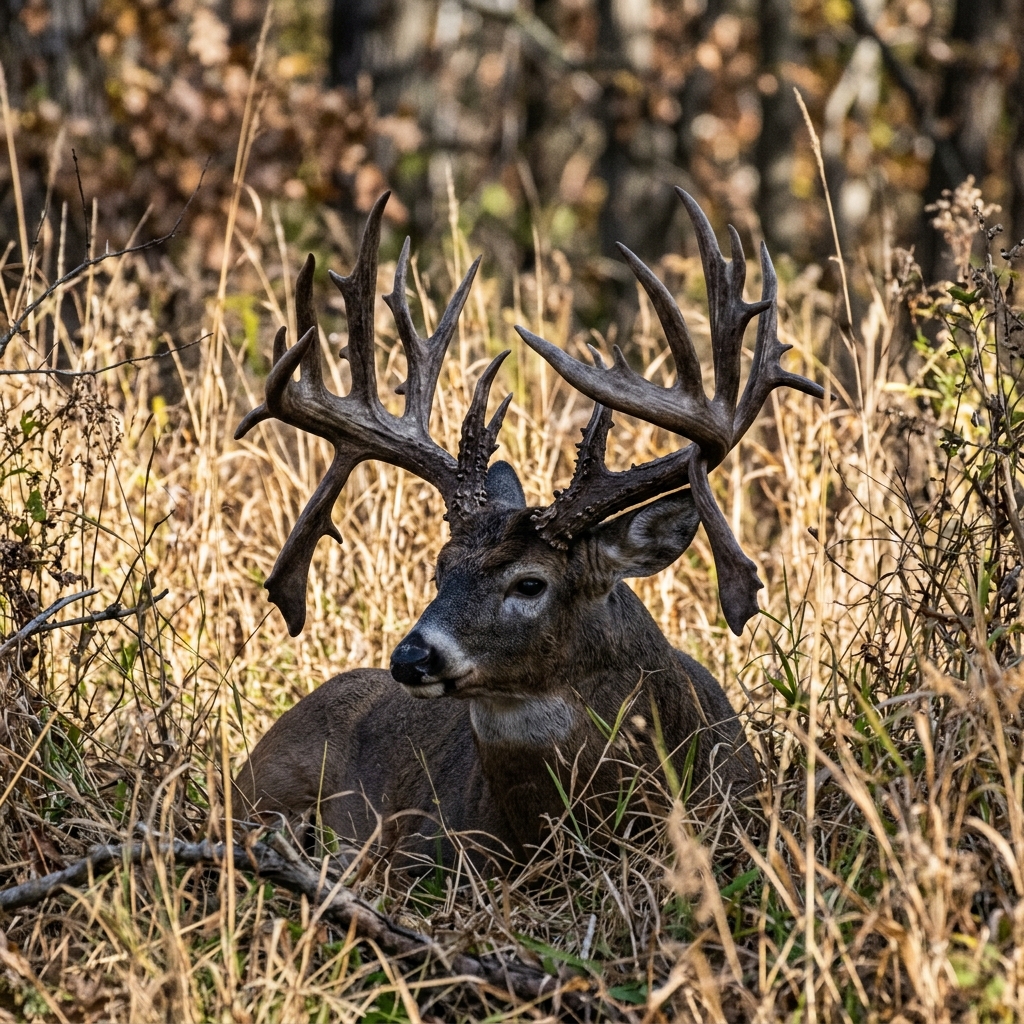
Understanding 'Drop Tines' and Non-Typical Antler Traits
What causes drop tines and non-typical racks? Learn genetics, pedicle stress, injury effects, and how hunters score and evaluate character bucks.
In the whitetail world, symmetry is the default. Hunters obsess over the outliers—the non-typicals. Stickers, kickers, palmation, and the most lusted-after trait of all: the drop tine. These abnormalities come from genetics, injury, age, and the messy biology of velvet-season growth. Understanding them makes you a better scouter, a smarter shooter on age-class decisions, and a more informed trophy-room curator.
What Is a Drop Tine on a Whitetail?
A drop tine is a point that grows downward from the main beam (or occasionally from another tine) instead of upward like typical upright tines. True drops have measurable length and usually add heavily to non-typical score.
Related “character” points hunters lump together:
- Stickers / kickers: short abnormal points off a typical tine or burr
- Forked G-tines: split typical points
- Palmated beams: flattened, moose-like sections
- Double brow tines / clustered bases: crowded growth near the pedicle
Not every downward bump is a legendary drop. Taxidermists and scorers care about length, location, and whether the point is abnormal relative to typical frame.
What Causes Drop Tines—Genetics or Injury?
Both happen. They are not mutually exclusive.
Genetic lineage
In some regions and deer families, abnormal point expression runs strong. Bucks throw character year after year—sometimes mirroring a father or grandfather’s frame. Land managers who protect mature age classes see more of these because the trait needs years to express fully.
Pedicle and velvet-stage stress
A heavy typical frame can stress the pedicle (the bony antler base on the skull). During velvet, blood-rich tissue is malleable. Micro-trauma, asymmetric loading, or localized damage can redirect cartilage and mineral deposition—sometimes producing clubbed or downward growth.
Local trauma to the antler
A velvet antler hit by a tine fight, fence, or branch can deform that side. Results range from a clean drop to a mangled cluster of junk points.
Trail-cam inventories across summers help separate “he always grows a drop” from “he wrecked that side in July.” If you catalog bucks annually, tools like Wildsnap’s species/activity organization make multi-year antler histories easier to track without losing folders—see Managing Trail Camera Data.
What Is the Contralateral Effect in Antler Growth?
One of the most reliable forensic rules in deer biology is the contralateral link:
- Injury to a buck’s left rear leg during antler growth often shows up as abnormality on the right antler (and vice versa).
- The nervous and developmental systems are cross-wired, so body trauma can map to the opposite antler.
What you’ll see:
- Stunted beam length on one side
- “Junk” points clustered near the base
- Late velvet peel or misshapen tines on the opposite side of the injury
Not every non-typical is contralateral trauma—but a buck limping in August with a wrecked opposite antler is a classic tell. For broader antler biology context, read Biology of Whitetail Antler Growth.
How Do Non-Typical Traits Affect Scoring?
Boone and Crockett / Pope & Young non-typical scoring adds abnormal points that typical scoring deducts or ignores differently.
Practical hunter takeaways:
- Measure everything abnormal—drop tines can add 8–20+ inches alone on elite bucks.
- Symmetry deductions still matter on typical frames; a one-sided drop often pushes a buck into non-typical entry strategy.
- Inside spread, mass, and beam length still build the foundation; character points are the multiplier.
- Green scores right after the kill shrink as antlers dry—expect some loss over 60 days.
If you’re learning the tape, use How to Score a Whitetail Buck before you argue camp scores.
Do Drop-Tine Bucks Behave Differently?
Antlers don’t change IQ, but age and survival history often correlate with non-typical frames:
- Many true character bucks are 4.5–6.5+ years old
- They bed tighter, move less in daylight, and use terrain to avoid pressure
- During the rut they can be just as vulnerable to decoys, scrapes, and doe timing as any mature buck
Don’t assume a drop-tine buck is “smarter.” Assume he’s older and has survived hunter mistakes. Hunt him like a mature deer: wind, thermals, and limited intrusion. Pair scouting with E-Scouting Whitetails and rut timing from Hunting the Pre-Rut Seeking Phase.
How Should You Photograph and Preserve a Non-Typical for Taxidermy?
Character racks deserve careful documentation:
- Photograph both sides, front, and rear before field dressing rearranges the head.
- Measure main drops with a flexible tape while memories are fresh.
- Tell the taxidermist which pose shows the drop—often a slight turn toward the character side. See Taxidermy Poses for Whitetail Mounts.
- Protect tines in transport—wrap with foam; drops catch on truck beds and door frames.
- If choosing a European mount, keep the skull plate intact for odd bases—guide here: DIY European Mounts.
Safety note: Non-typical bucks are often big-bodied survivors. Confirm the animal is dead (blink reflex with a long stick) before you grab antlers. Multiple drops mean more puncture points if a “dead” deer surges.
Can Habitat and Nutrition Create More Non-Typicals?
Nutrition doesn’t invent a drop-tine gene, but it unlocks expression:
- High-protein spring/summer forage supports larger frames where abnormalities have room to show
- Mineral access and low stress help bucks reach older age classes
- Overharvest of 2.5-year-olds removes the age window where character often appears
Managers who want more non-typicals should prioritize age structure first, genetics second, and food third—not the reverse.
How Should You Judge a Non-Typical on the Hoof?
Character can fool your eyes in low light. Before you settle the pin, run a quick field checklist:
- Body age first: Look at belly sag, brisket depth, and face length—not just antler weirdness.
- Frame vs. junk: Is there a solid typical frame underneath, or is the rack mostly clustered mass with weak beams?
- Both sides: Glass the off side. A hidden drop or broken tine changes taxidermy and score plans.
- Shot opportunity quality: A non-typical isn’t worth a low-percentage shot through brush. Lane discipline still rules—see Cutting Shooting Lanes.
Campfire “he’s 180 non-typical” estimates are famously optimistic. If management goals on a lease or farm prioritize mature age class, a clean 4.5-year-old with a kicker may be a shooter even if green score isn’t magazine material.
Do Stickers and Kickers Mean the Same Buck Next Year?
Not necessarily. A sticker born from velvet trauma can vanish the following year, while a genetically wired drop may return bigger. That’s why summer camera inventories matter: velvet photos in July–August are your crystal ball.
Photograph bucks from consistent angles at mineral sites when legal and ethical in your area, then compare year-over-year. Label folders by nicknames (“Fork Drop,” “Right Stick”) instead of estimated inches. Inches lie; silhouettes and beam mass trends tell the truth.
How Do Taxidermists and Scorers Talk About Character Differently?
Hunters, scorers, and taxidermists use overlapping words with different priorities.
Scorers care whether a point is typical or abnormal, whether it reaches the length minimum, and how it affects deductions or non-typical additions. Taxidermists care whether a drop will stab the wall, fight the ear, or look better with a left vs. right turn. Hunters care about the story and the photo over the mantel.
Before you green-score around the truck, decide your destination: B&C/P&Y entry path, wall mount pose, or European. That decision changes how carefully you protect tines in transport and what you ask the shop to rebuild. A fragile 9-inch drop that snaps in the bed of the truck becomes a different animal—and a different mount conversation.
Frequently Asked Questions
Are drop tines rare?
True, long drop tines are uncommon relative to typical racks. Short kickers are more common. Frequency rises in older age classes and certain regional bloodlines.
Will a buck grow the same drop every year?
Sometimes yes (genetic), sometimes no (injury-year only). Multi-year camera history is the only honest answer for a specific deer.
Does a broken tine in season become a drop next year?
Not exactly. A hardened antler break doesn’t “turn into” a drop. Next year’s growth depends on pedicle health, genetics, and velvet-season events.
Should I arrow a young buck with a small kicker?
That’s a management choice. A 2.5-year-old with a tiny sticker is usually still a young deer. Judge age and body first, antler novelty second.
Do non-typical mounts need special taxidermy care?
They need careful packing and pose planning so character points aren’t hidden against the wall. Older historic mounts may also carry dusty finishes—wash hands after handling vintage heads.
Drop tines are part genetics, part trauma, part time on the hoof. Learn the biology, score honestly, and hunt the age class—not just the Instagram antler.
Build a cleaner history of your herd
Spend less time sorting and more time seeing what matters—when detections are organized by time and class.
No credit card
Wildsnap • Open beta
Build a cleaner history of your herd
Spend less time sorting and more time seeing what matters—when detections are organized by time and class.
No credit card