
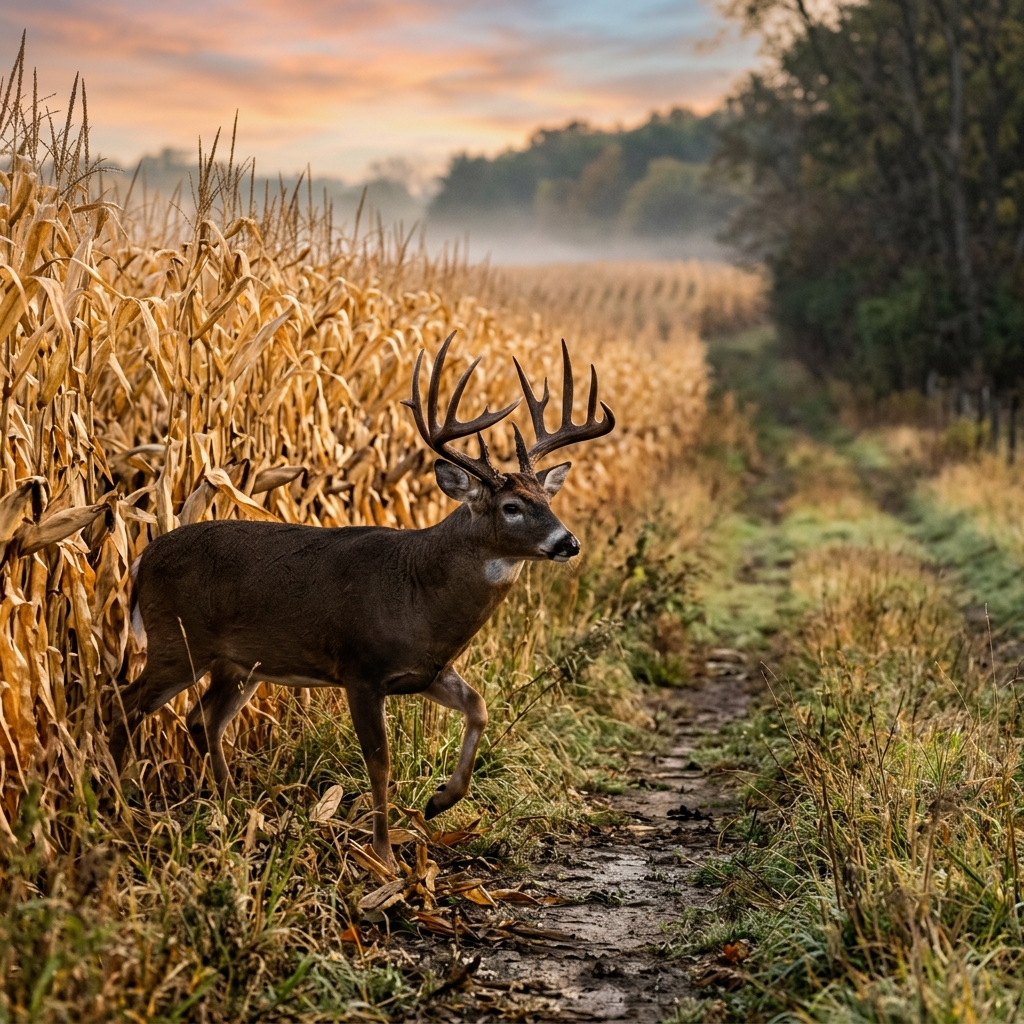
How to Hunt the Fringes of Standing Corn: A Tactical Masterclass
Hunt standing corn the smart way: washout hubs, timber seams, crosswind fringes, and harvest-week adjustments—without pushing rows or risking combines.
In Midwestern farm country, standing corn rewrites the season. To a hunter, a 200-acre field is an impenetrable wall of stalks. To a mature buck, it is a 10-foot cafeteria and bedroom where he can bed, feed, and travel screened from eyes and sun.
Pushing corn is usually loud futility. The consistent play is the fringe ambush—killing bucks as they use edges, washouts, and timber seams before combines erase the fortress.
Why Bucks Live in Standing Corn
Corn delivers calories and security at once:
- Endless browse and waste grain
- Visual walls that break silhouettes
- Acoustic cover when dry leaves roar in wind
- Shade in early season heat
Until harvest, many bucks daylight inside the field more than in timber. Your cameras on woods scrapes may go quiet while the real pattern is three rows deep in yellow gold.
Corn Rows as Travel Corridors
Fields look chaotic; deer treat planted rows like hallways.
Acoustic advantage: wind in dry corn masks footfalls. Bucks often shift midday under that roar when timber feels risky.
Washout hubs: find gaps from poor drainage, rocks, or drowned seed. These bare pockets become social hubs inside the field—staging, sparring sign, and droppings concentrated where stalks open.
Scout edges for trails exiting washouts toward timber, creeks, or neighbor plots. Those exits are stand sites; the field interior is usually not.
The Fringe Ambush Framework
You cannot archery-shoot 40 yards into dense corn. Hunt geometry.
Transition seams where corn meets:
- Timber or CRP
- Brushy fence rows
- Creek bottoms and ditches
- Cut hay or bean edges
Bucks often pace the first 2–3 rows, scent-checking the seam for 10–20 minutes before crossing. Hang 15–30 yards into cover off the seam, not silhouetted on the field road.
Morning vs. evening seam choice differs—food staging favors evenings; return-to-bed trails can favor mornings. See morning vs. evening deer hunting.
Wind Rules Unique to Corn
Corn is a humid scent trap. On calm evenings, odor pools in rows and educates every deer using that edge.
Hunt fringes when a steady 8–12+ mph crosswind pulls scent out of the corn into a void—open pasture, a road, or a known non-bedding block. If wind dumps odor down the rows toward bedding washouts, stay out.
Scent clothing still helps at the seam; it does not beat a bad wind. Refresh habits via whitetail scent control.
Cameras on Corn Edges Without Burning Access
Cellular cameras shine on fringe trails and washout exits because you can avoid weekly walks along the farmer’s best deer edge.
Placement ideas:
- Fence crossings between corn and timber
- Inside-corner seams (classic funnels)
- Trails leaving washouts at dusk headings
Mount discreetly and legally; ag edges see human traffic. Theft and mounting tips: securing trail cameras on public land (principles apply on leased ag too). Pattern building: cellular trail cameras for deer hunting.
Harvest Week: When the Fortress Falls
The day combines roll, patterns shatter. Deer relocate to standing blocks, timber, or leftover grain.
Tactical notes:
- Ask the farmer for the harvest schedule
- Be ready to shift stands the same week cover disappears
- Fresh tracks into remaining standing pockets matter more than historical summer cams
- Cut fields can create new evening edges overnight
Hunters who pre-hang only timber stands get surprised; hunters who map multiple seams adapt in 24 hours.
Ag Safety: Machinery and Chemicals
Commercial fields add hazards timber hunters forget.
Combines and tractors: never hunt or walk rows during active harvest. Camouflage in the first row is invisible to an exhausted operator in low light. Multi-ton headers do not stop for surprises.
Chemicals: fertilizers, herbicides, and desiccants can irritate skin and lungs. Avoid wet treated stalks; wash gear after brush-ups; respect re-entry intervals if the farmer discloses them.
Permission: know exact boundaries. Corn looks the same on both sides of a line.
Access and Pressure Management
Ag edges get hammered on weekends. Improve odds by:
- Hunting weekday evenings when wind is right
- Entering via ditches or creek beds, not the gravel field road
- Limiting sits on the hottest seam to once or twice per week
- Having a backup seam when the primary gets lit up
Inside-corner funnels on leased ground deserve the same restraint you give a 10-acre woodlot sanctuary.
Glassing and Map Work Before You Hang
Corn looks uniform from the road. It is not.
Pre-season or mid-season scouting without intrusion:
- Satellite imagery for drowned corners and skinny fingers of corn
- Glass from the truck at last light for exit trails into timber
- Talk to the farmer about hybrid height, harvest timing, and wet holes
- Mark inside corners where two cover types meet the field
Those inside corners concentrate travel the way topography saddles do in timber. A camera on the fence post covering the corner often outperforms a random mid-edge unit. When patterns confirm, hang once on the downwind timber side—not in the gravel turnrow everyone drives.
Bow vs. Firearm Adjustments on the Fringe
Archery hunters need deer to step out of the first rows into a 20–30 yard lane. That may mean subtle hinge cuts or natural openings prepared early. Firearm hunters can cover longer edges but still benefit from predicting exact crossing points instead of hoping a buck materializes somewhere along 300 yards of stalks.
Either way, define a specific shooting window and ignore the rest of the field. Infinite corn creates infinite excuses to shift and squeak. Pick a lane, commit, and let the wind work.
After the Combine: Waste Grain and Relocations
Post-harvest, deer often hit waste grain on evening winds, then bed in the nearest thick timber or CRP. Your fringe stands may go cold for three days, then revive on a new trail 80 yards down the fence.
Rebuild quickly:
- Walk cut edges at midday once for tracks (with permission)
- Move a mobile stand to the freshest timber entry
- Watch neighboring standing fields if any remain
- Expect noon movement on cold days when deer re-feed in cut fields
The hunters who kill the week after harvest are the ones who treated corn as a temporary map layer—not a permanent stand tree.
Lease Politics and Farmer Relationships
Corn fringe hunting dies when relationships die. Protect access:
- Confirm parking spots that never block equipment
- Text before hunting when harvest is imminent
- Offer labor or a gift of packaged venison after season
- Report fence damage you find—even if you did not cause it
- Never cut fences or stalk rows without explicit permission
Farmers talk. One disrespectful hunter can close a section for a whole friend group. The best “tactic” on ag ground is often being the easiest hunter to host. When patterns shift after harvest, ask which fields will be disked next—they usually know before your cameras do. For food-plot style attraction on ground you control adjacent to corn, poor man’s food plots can create evening staging when standing corn finally falls.
Night Exits Along Field Edges
Leaving a corn-edge sit after dark means navigating ditches, electric fences, and uneven turnrows. Mark your exit with reflective tacks on the walk in. Keep a headlamp accessible before you need it. Dragging a deer along a fence line at 9:00 PM is when people cut themselves on wire they forgot existed. Plan the recovery path when you hang the stand—not after the shot.
If a sit feels wrong because harvest trucks are idling nearby, climb down and come back another day. No buck is worth a machinery accident or a ruined farmer relationship. The fringe will still be there when the combine moves to the next section—and the deer often move with it in predictable ways you can intercept safely.
Frequently Asked Questions
Should I still-hunt inside standing corn? Rarely for archery. Noise and limited shooting lanes favor fringe ambushes.
Where exactly should I hang? Off the seam covering trails from the first rows into timber or along washout exits—downwind of the approach.
What wind is best? A steady crosswind that carries scent out of the corn away from bedding rows.
Do bucks stay after harvest? Some shift to nearby cover and return for waste grain; patterns change fast—rescout immediately.
Is rattling effective on corn edges? Pre-rut soft tending calls can work on seams; avoid educating a hot edge with constant aggressive rattling.
Standing corn is a temporary fortress. Hunt the fringes, respect machinery, watch the wind, and be ready the week the cover disappears.
Wildsnap • Open beta
Join Wildsnap and try the beta
In the open beta, you turn trail-cam data into actionable insights—free, fast, and simple.
No credit card