
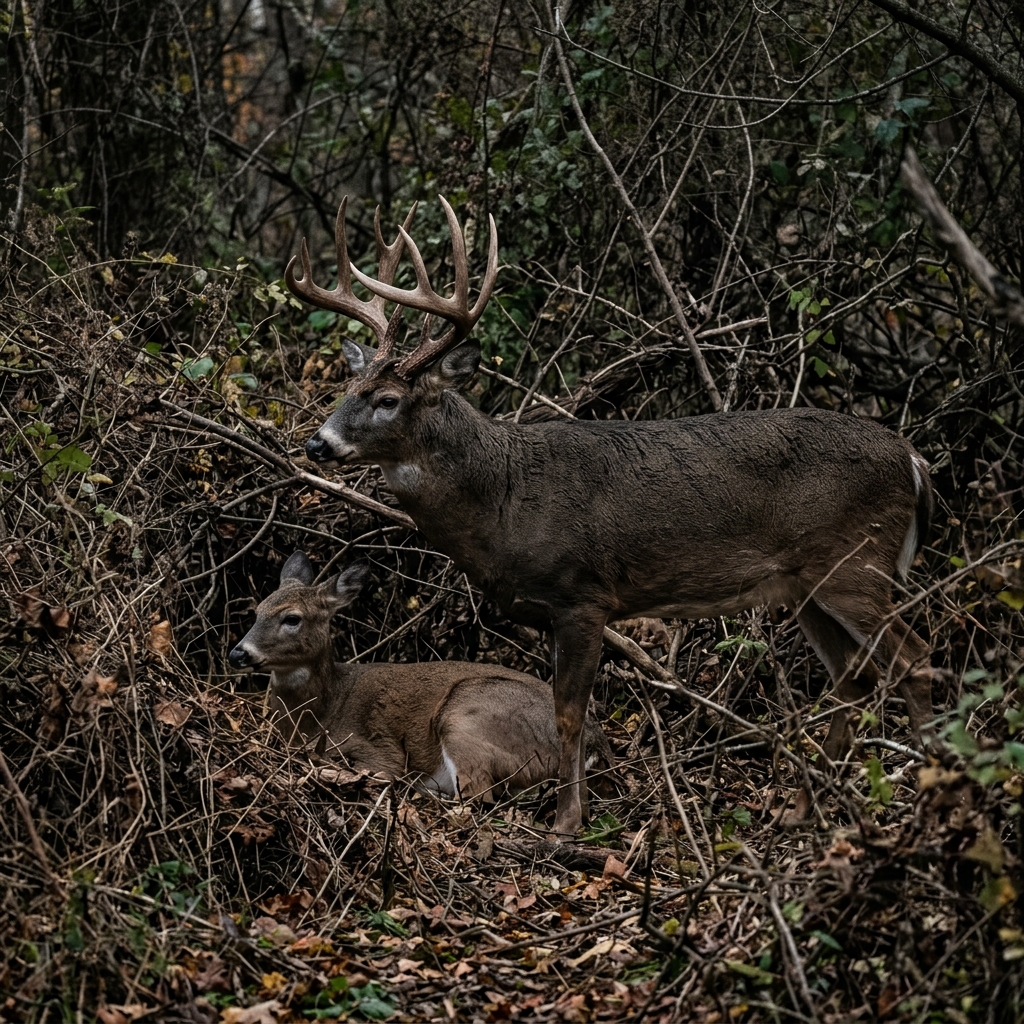
Hunting the 'Lockdown' Phase of the Rut: Advanced Strategies
When the rut goes quiet, hunt lockdown micro-cover, swamp islands, and slow still-hunts—with timing, gear, and safety for the tending phase.
The lockdown phase is the most frustrating stretch of the rut for many hunters. One week the timber is chaos; the next it feels empty. Deer did not vanish. Mature bucks have paired with estrus does and tucked into the nastiest micro-cover on the property.
If you keep sitting classic field-edge funnels all day, you are often watching a ghost town. Take the hunt to the bedrooms—carefully.
Biology of the Tending Phase
When a dominant buck isolates a doe within roughly 12 to 24 hours of standing heat, he stays glued to her. His job is to keep satellite bucks away until breeding finishes.
- Travel distance can drop dramatically for 24 to 48 hours per doe.
- He pushes her off open fields into thick, overlooked cover.
- He moves when she moves—often short loops to water or browse.
Across the herd, overlapping lockups usually create a 5- to 7-day quiet window. Individual bucks exit lockdown and immediately resume seeking—so patience still pays.
Where Bucks Lock Down
Forget big scrape lines for a few days. Look for weird, tiny security:
- Micro-cover islands: A lone cedar clump in CRP, a brush pile in a pasture, a 1/4-acre briar knot.
- Swamp high spots: Dry humps inside cattails or flooded timber—classic swamp buck real estate.
- Leeward thickets: Dense cover on the downwind side of doe bedding so he can scent-check rivals.
- Terrain pockets: Ditches, oxbows, and hinge-cut tangles nobody wants to walk.
E-scout these pockets before the quiet week hits using map layers and lidar tips.
Infiltration Tactics That Work
Traditional funnel sits go cold. Higher-odds moves:
- Hang on the fringe of nasty cover facing bedding, not the destination field.
- All-day sits near water holes between thickets—paired deer drink; see hunting over water.
- Slow still-hunts on the downwind edge of CRP, clear-cuts, and briars. Move in feet, not yards. Glass for an ear flick or horizontal back line.
- Short relocations: If a pocket is empty at noon, ease to the next island instead of staring at open oaks.
Still-hunting skills from spot-and-stalk / still-hunting transfer well—slow is the whole method.
Timing the Bounce-Back
When a buck finishes with a doe, he often leaves fast to find the next. That creates sudden daylight cruising again.
- Do not abandon the timber for the field edge at the first quiet day.
- Keep one stand in thick cover and one on a travel funnel for the restart.
- Midday movement remains real—pack food and stay put.
If you hunted hard through the pre-rut seeking phase, lockdown is the mental test that follows. The deer are still there.
Gear for Thick-Cover Lockdown Hunts
- Binoculars on a harness (identify before raising a weapon)
- Quiet wool or softshell layers—briars shred nylon loudly
- Mobile saddle or lightweight hang-on for odd trees
- Drag rope / game bags staged for nasty extractions
- Blaze orange for any ground stalking during firearms overlap
- Wind checker every 10 to 15 minutes in swirling bottoms
Safety: Stalking and Friendly Fire
Creeping bedding cover in camo makes you look and sound like a deer.
- Wear blaze orange on head and torso when laws or shared properties demand it—err on visibility.
- Never use a rifle scope to glass unknowns in brush; use binoculars.
- Know who else is on the lease; announce still-hunt zones on the sign-in board.
- Muzzle control is non-negotiable in thickets.
Shared-property discipline ties back to lease pressure rules.
Mistakes During Lockdown
- Quitting at 10 a.m. because “nothing is moving”
- Sitting the same open funnel that produced last week
- Crashing through bedding at full speed “to jump something”
- Overcalling—locked bucks with a doe often ignore rattling
- Leaving thick cover the day before the bounce-back
Lockdown Week Checklist
- Map 5–8 micro-cover pockets in advance
- Pack all-day food and layered clothing
- Confirm water sources near thickets
- Tell partners your still-hunt routes
- Rest any pocket you bump hard
- Reopen funnel sits when chasing resumes
Reading Sign That Lockdown Is Active
Clues the quiet week has arrived:
- Scrapes that were torn up daily suddenly look stale for 48+ hours.
- Field-edge cameras go dark while thick-cover cams show pairs.
- You glass empty ag at dawn that held chasing last week.
- Rub lines look old; fresh tracks concentrate in one briar pocket.
Do not confuse a warm-front lull mid-seeking with true lockdown. Seeking bucks still cruise between doe groups; locked bucks barely leave a 1- to 3-acre cell.
Still-Hunt Route Planning
Pick a downwind edge and commit to a 200- to 400-yard route that takes 60 to 90 minutes:
- Step only when woods noise (wind, squirrels) covers you.
- Glass every 10 to 20 yards into cover before moving.
- Expect deer bedded facing downwind—approach with that in mind.
- If you jump a pair, mark the spot, back out, and hunt the fringe next sit instead of chasing blindly.
- End the route at a stand tree for a quiet afternoon sit if legs are spent.
This is chess, not a deer drive. Speed ruins the only advantage you have in thick cover.
Field Notes and Practical Numbers Use these benchmarks to keep decisions concrete rather than vague:
- Log every sit with date, wind direction, temperature, and deer observations—patterns appear after 8 to 12 recorded hunts on the same property.
- Limit first-time pressure on a hot pin to one quality sit, then rest at least 24 to 48 hours unless the rut calendar demands otherwise.
- Carry a short checklist in your phone notes so gear and safety steps do not depend on memory at 4:30 a.m.
- Revisit your plan weekly during the season; crops, pressure, and breeding phases change the right answer.
- When in doubt, choose the option that leaves mature deer less educated for the next sit—longevity beats one burned encounter.
These habits compound across a season and across years on the same ground.
Successful hunters treat preparation as part of the hunt itself. Write down what worked, what failed, and what you will change next time. Small improvements in access, timing, and patience usually matter more than buying another gadget. Stay flexible after weather swings, keep safety non-negotiable, and measure success by clean opportunities and ethical recoveries—not only by antlers on the wall. Over a full season, disciplined routines outperform random hard hunting.
Calling, Decoying, and What to Skip Lockdown changes the call playbook:
- Soft contact grunts near cover can stop a buck trailing a doe at 40 yards.
- Loud rattling sequences are lower percentage than during seeking—use sparingly.
- Estrous bleats sometimes pull a tending buck a few steps for a shot; do not overdo it.
- Open-field decoys often sit alone while real pairs are in thickets—move decoys to edges of micro-cover if you use them at all.
- If you bump a pair, do not keep calling from the same tree that afternoon.
Patience and position outperform noise when biology says he is already occupied.
Frequently Asked Questions
How do I know lockdown started?
Daylight chasing collapses, scrapes go stale, and cameras in open funnels quiet while thick-cover cams still catch pairs. Calendar timing varies by latitude—often early to mid-November in much of the Midwest.
Should I rattle during lockdown?
Soft tickling near cover can work on satellite bucks; loud fight sequences are lower odds than during seeking. Sight-calling a buck already with a doe is usually wasted motion.
Is driving deer a good lockdown tactic?
On small properties, aggressive drives can blow out the sanctuary for the rest of season. Prefer slow solo still-hunts or edge sits.
How long should I sit in one thick pocket?
If wind is good and access was clean, 6 to 10 hours is reasonable. Relocate if thermals turn or you bump the pair.
What comes after lockdown?
Seeking/chasing resumes, then breeding winds down into post-rut food patterns. Keep one setup ready for open cruising again.
Lockdown rewards hunters who trust biology over boredom. Get tight to nasty cover, stay patient through the quiet days, and be ready when he stands up for water or leaves to find the next doe.
Confirm seasonal patterns from your cameras
Find patterns and time your hunts right when your camera history tells you what happened — and when.
No credit card
Wildsnap • Open beta
Confirm seasonal patterns from your cameras
Find patterns and time your hunts right when your camera history tells you what happened — and when.
No credit card