
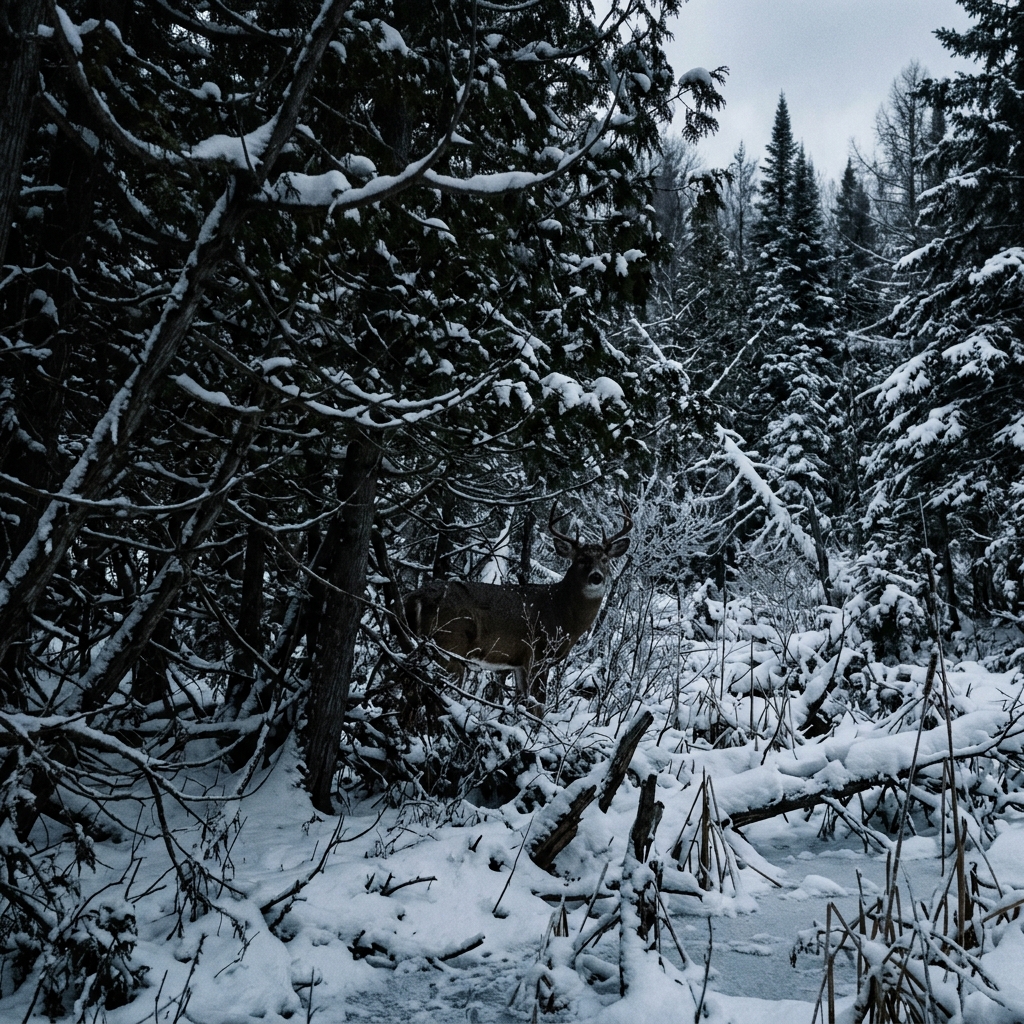
How to Hunt Cedar Thickets and Conifer Swamps: The Winter Fortress
Dense cedars offer thermal cover deer need to survive winter. Learn edge tactics, midday sits, and how to hunt conifer swamps without blowing the sanctuary.
When January temps drop below zero and northwest winds cut hard, whitetails lean on thermal cover. Dense cedar thickets, spruce pockets, and conifer swamps trap ground heat, block wind, and keep snow shallower under the canopy. In the northern half of the country, these stands are some of the most predictable late-season locations on any map.
The biggest bucks did not get old standing in open ag fields at noon. They live in dark timber and move when caloric need forces them. If you want consistent late-season contact, learn to hunt the edges of that fortress—not the bedroom itself. Pair this habitat with late-season food tactics and a solid cold-weather layering system.
Why Conifers Beat Bare Hardwoods in Deep Cold
A mature cedar thicket is more than “cover.” It is a micro-climate.
Heat trap
Interlocking evergreen canopies block wind and hold radiant heat from the soil. Inside a thick stand, ambient air can run 10–15°F warmer than an open hardwood ridge on the same morning. That difference cuts the calories a deer burns just to stay alive.
Snow vault
Broad cedar and spruce limbs catch snowfall high in the canopy. While open timber holds 18–24 inches of crusty snow, the ground under dense conifers may hold only 2–4 inches. Easier walking means lower energy cost—and more willingness to move short distances in daylight.
Acoustic security
A carpet of dead needles is quieter under a deer’s feet than frozen hardwood leaves. Your approach from outside the thicket, by contrast, sounds loud. Bucks bedded inside rely on hearing as much as vision.
Mapping Entrances, Exits, and Doe Bedding
Do not treat the swamp as one blob. Break it into structure:
- Low tunnels where limbs have been rubbed smooth by daily travel
- Wet seams and spruce islands slightly higher than surrounding muck
- South edges that catch weak winter sun for afternoon loafing
- Trails that connect the thicket to standing corn, brassicas, or cut beans
Does often bed in the densest cover. Bucks stage on the fringe or cruise the downwind edge. Mark last light trails with e-scouting first, then confirm with muted midday scouting so you are not cutting fresh tracks through the core every evening.
Note which side of the thicket faces prevailing winter wind. Deer bed on the lee side when possible—your access route should never cross that lee pocket upwind of beds.
Edge Tactics: Hunt the Seams, Not the Core
Walking straight into a cedar thicket is usually the worst move.
Scent trap
Dead air inside dense conifers does not flush scent well. Your odor can hang in low limbs for days and push deer onto neighboring ground. Treat the interior like a sanctuary.
Tunnel ambush
Find beaten entry/exit tunnels where deer leave cover for evening food. Hang 20 yards downwind of those seams on the outside of the cover. You want to intercept the first move—not bump the bed.
Midday sub-zero window
When deer feel secure and the warmest air arrives around 1:00–2:00 PM, they often stand, browse low cedar tips or nearby woody browse, and shift beds. On days below 15°F, staying until early afternoon beats leaving at 10:00 AM. That midday cruise is real in thermal cover.
For swamp-specific travel and pressure ideas, see swamp buck tactics.
Stand and Saddle Setups That Work
Practical setups for conifer edges:
- Timber transition sit — where cedars meet hardwoods along a travel bench.
- Food-edge pinch — a fence, ditch, or creek that funnels deer from thermal cover to a late food source.
- Leeward fringe — slightly off the thickest cover so your scent drains away from beds.
- Mobile relocation — if snow tracks show a new exit after pressure, move 75–150 yards rather than forcing a burned funnel.
Keep shooting lanes minimal. In dark timber, deer appear close and fast—know your distances before legal light. Ground blinds work on frozen swamp edges where tree hang options are limited; brush them in with native boughs and enter only when deer are absent.
Reading Wind and Thermals in Swamp Timber
Low, wet ground behaves differently from ridge tops. On calm, bitter mornings, cold air pools in bottoms and can hold scent near the surface. A “good” wind on a ridgetop stand may lie to you in a cedar bowl.
Use thermals as a second check: rising morning air can pull scent uphill if you set too low. Afternoon cooling reverses the flow. When in doubt, sit higher on the fringe rather than deep in the bowl where scent gets trapped under needles.
Gear for Wet, Dark Timber
Conifer swamps are muddy, branchy, and cold when you stop moving.
- Pack heavy insulation and put it on at the tree—walk in light to avoid the sweat-freeze cycle
- Clear wraparound eye protection for limb slap at dawn and dusk
- Waterproof boots with aggressive tread for frozen mud and hidden roots
- Hand warmers and a quiet seat for long midday sits
- Offline maps—cedar grids look identical once you are inside
Hypothermia risk spikes when wet base layers meet a long sit. Change gloves if they soak, and keep a dry layer in a waterproof stuff sack. Ice cleats or screw-in boot studs help on frozen skid trails around swamp margins. A trekking pole with a rubber tip reduces noise on frozen mud and gives balance when crossing root tangles in the dark.
Tracking and Recovery in Conifer Cover
Blood trails in cedar duff are harder than on snow or leaves. The dark needle bed absorbs blood and hides sign. Mark last blood with flagging tape on the trail side, not on branches deer might see.
If you jump a deer from thermal cover, expect short bursts then tight re-beds nearby. Slow down immediately—pushing a wounded buck deeper into a swamp you cannot access costs recoveries. For difficult trailing, see expert blood trailing tips.
Pressure Management and Sanctuary Rules
If you bump deer from the core twice in a week, daylight use collapses. Rules that keep a thicket productive:
- Scout the perimeter; save interior walks for recovery or one deliberate push after a fresh snow
- Rotate stands so you are not cutting the same entry every sit
- Hunt the absolute best wind only—marginal winds educate bedding deer
- Leave the thickest island alone if it is your only late-season bedroom
Thermal cover is finite on many properties. Protect it like a food plot you cannot replant in December. One sloppy entry before a cold front can shut down a thicket for the rest of the season. On public land, assume other hunters will also discover the edge—arrive early on cold fronts and treat every sit as if someone bumped the core yesterday.
Frequently Asked Questions
Do deer actually eat cedar? They browse cedar and other woody tips when preferred foods are buried or depleted. It is survival forage more than preference—but it keeps them tied to the stand in deep winter.
How close should I hang to a cedar bedding pocket? Often 20–40 yards off the primary exit, never in the bed itself. Closer only if wind, cover, and access are perfect and you can enter without being heard.
Are spruce and pine as good as cedar? Dense spruce and white pine can work similarly if canopy and stem density block wind. Cedar swamps often win on snow interception and thermal feel, but any dark conifer block beats open hardwoods in a blizzard.
Should I rattle or call in a conifer swamp? Late season calling is usually low-percentage. Food and thermal need drive movement more than social curiosity. Soft contact bleats on the edge can work; aggressive rattling often bumps pressured deer.
What temperature threshold makes midday hunting worth it? As a rule of thumb, when highs stay under 20°F (and especially under 10°F), midday movement near thermal cover improves. Pair cold with a nearby high-energy food source for the best odds.
Can I still-hunt through cedar thickets? Only on the outer fringe or defined tunnels. Interior still-hunts push beds and contaminate scent. Save still-hunting for transitions between swamp edge and food—not the bedroom core. Move one slow step at a time and pause after every third step.
Respect the dark timber. Hunt the wind-blown edge, stay for the noon move when it is bitter cold, and leave the bedroom intact.
Wildsnap • Open beta
Join Wildsnap and try the beta
In the open beta, you turn trail-cam data into actionable insights—free, fast, and simple.
No credit card